Some misc. "quirks" I encountered in setting up a build pipeline from Unity (on Windows) to Android on a Nexus 7... some is mentioned on Unity's Android quickstart docs, some required additional research. Anyway, if you're having problems, here's a pile of different things to try:
Monday, March 4, 2013
Friday, March 1, 2013
Castle of the Red Prince, by CEJ Pacian

The best part of his work, though, is that these genres and settings aren't really the point. In Gun Mute, Walker and Silhouette, as well as this newest entry, Pacian is clearly more interested in formal experimentation on a small but vital scale, and the genre is just a shortcut to approach narrative effect faster. What if navigation doesn't involve cardinal directions? What if everything is a metaphor? Above all, Pacian is interested in re-configuring how we perceive and navigate through space, in a way that only interactive fiction can afford.
Castle of the Red Prince's experiment, then, might follow these rationales:


Wednesday, February 27, 2013
This one's for the hometown fans.

Friday, February 22, 2013
PlayThings, a toys and play symposium, 23-24 Feb 2013 at Parsons

6 East 16th St, 12th flr
in NYC (near Union Square)
February 23rd - 24th
11 am - 5pm
Day 1:
a panel discussion around the ideas of play led by:
McKenzie Wark (Lang)
Colleen Macklin (PETLab)
Zach Gage (stfj.net)
Cas Holman (RISD)
moderated by John Sharp
+
a 3hr play session with various kinds of toys and games i.e. historical toys, mechanical toys, building blocks, plushies/puppets/dolls, board games, video games and physical games to introduce participants with the variety of things and activities that constitute as play.
(led by Kyle Li and Nick Fortugno)
Day 2:
Day 2 consists of a day-long workshop and play-jam session where participants come up with their own games, toys or other forms of public play and the creations are later reviewed by the panel and other participants.
(5 hr making + 1 hr judging/playtesting)
(basic toy building materials provided)
Thursday, February 21, 2013
Game narrative as improvisational theater / negotiation.
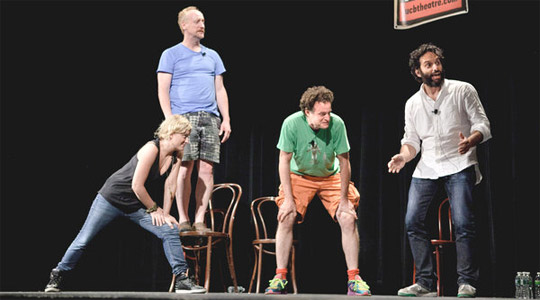
The current narrative systems prototype Shakespeare has been somewhat disappointing so far: the director switches, seemingly erratically, between 5-6 different plot threads, and nothing seems coherent. I need a way of (a) allowing the player to influence story pacing / scope, and (b) a way for the system to push back, to try to force some story pacing / scope.
For this, I'm looking at how improvisational comedy generates and upholds structure. You might've heard that improv is about "always saying yes," but there's a lot more to it, apparently.
Specifically, longform improv comedy involves actors cooperating to "find the game" -- to find the core of a joke. Each actor makes "offers" to expand upon a premise and move action forward, hopefully toward a funny destination, and usually, actors err on always accepting offers ("saying yes") and building upon it since "blocking" offers frustrates your scene partners. However, it's very possible to "say yes" to a premise while still "blocking" the "game."
Here's an explanation from an NYC improv comedy personality, Will Hines:
Subscribe to:
Comments (Atom)