Saturday, March 23, 2013

Summer 2013 @ NYU GameCenter

This summer, I'll be teaching 6 week Unity studio intensives at NYU Game Center. The "regular" class during the semester is usually 15 weeks, so trying to fit all that material into a summer course will be, uh, interesting.

The sessions themselves are pretty expensive, but I believe that they do count for credit that you can put toward a degree. I believe non-students can also take it for non-credit status, which might be cheaper? Unfortunately, I don't set the price, so all I can do is to try to help you get your moneys' worth. You can look at the Github for "Building Worlds", the (15 week) Unity course I'm teaching at Parsons right now -- as well as a blog post on my general approach to game development education.

You'll, uh, also get to hang out with me, I guess. That's a perk, right?

Tuesday, March 19, 2013

#lostlevels is an indie unconference on March 28th 2013, 1 PM, downtown San Francisco.


Lost Levels is a hyper-inclusive "unconference" about games and play that is FREE to attend, open to all, and anyone can run a session. It takes place Thursday afternoon of GDC week, in San Francisco. I'm co-running it with Harry Lee, Ian Snyder, and Fernando Ramallo.

I don't know about the others, but the main motivation to organize this, for me, was about imagining an alternate world. Yes, GDC conference sessions are fun, but they're really just an excuse for us all to get together and hang out, and we need a giant conference to motivate us all to fly over and converge in one place.

At its core, it's all about hanging out with people and enjoying each other. Everything else is just a fun ritual to facilitate that. But many people don't have GDC passes -- so what happens to them? The ritual isn't as fun if it prevents people from joining.

Our community will, inevitably, be incredibly diverse, chaotic, and messy. We should embrace the messiness and accept that diversity, and strive to lower barriers.

Please visit the site for more details and sign-up if you'd like to attend or give a talk or run a coloring session or dance it out to Tetris music or eat sandwiches. Thanks.

Saturday, March 16, 2013

simian.interface, and filler puzzles as phenomenology.


simian.interface, by Vested Interest, is a game that never tells you the controls or how to play or what your goals are, but you'll immediately intuit all of those things just by interacting with it. In this sense, it's very toy-like: you're just playing with this thing, tossing it and turning it over in your hands. No instructions, hardly any rules.

Nominally, it's also a "puzzle game", but it really doesn't fit into the popular sense of a puzzle game. There's this concept of "filler puzzles" among puzzle games, where puzzles that don't demand any new skill or understanding from the player are not as valuable as more novel puzzles. You can be assured that in a Stephen Lavelle puzzle game, for example, every single puzzle has been consciously constructed and filtered and curated over the course of dozens of playtests. Same thing in Jelly No Puzzle: there's always a bit of additional new lateral thinking that trips you up.

In this sense, simian.interface is an awful puzzle game because it is made almost entirely of filler puzzles -- you're just doing the same thing over and over, and the shapes change a little bit. Most levels take about 15 seconds to complete.

... Except it's a puzzle game where the formal novelty of the puzzles doesn't matter?

Thursday, March 14, 2013

Course catalog at Radiator University, Spring 2013

If I had a university, these are some of the courses I'd run:

GD 202: LEVEL DESIGN STUDIO: SPACE AND DATA
There are two paradigms of level design in video games: the level as a constructed space, an architectured environment -- and the level as pattern of challenges, a series of situations and encounters. Students will build floorplans in Doom and engineer enemy attack waves for bullet-hell SHMUP games, build custom chess and checkers boards, and populate Skyrim dungeons with systemic parameters. We will also read an introductory body of architectural criticism and attempt to realize that theory as first person levels in Unity. In the end, we will argue that space and data are actually the same.
(4 credits; meets twice a week; satisfies "Spatial" breadth req.; Paris campus only)

DH 100: INTRODUCTION TO DIE HARD 1 STUDIES
This is the introductory course to Die Hard 1 Studies for students interested in majoring in Die Hard 1. We will watch Die Hard 1 every three weeks. In between screenings, we will read the novel it is based upon ("Nothing Lasts Forever" by Roderick Thorp), play Die Hard Arcade, tour several local modernist skyscrapers, and re-create scenes from the film in both analog and digital formats. By the end of the semester, students will be able to argue persuasively that Die Hard 1's many sequels do not actually exist.
(3 credits; meets once a week; bring your helicopter pilot license to the first class)

Monday, March 11, 2013

GDC tips

It's GDC season again... Daphny has a lot of helpful advice on having a good time at GDC, so make sure you read that. Here's some bits of my own:
  • My write-up / thoughts / post-mortem of GDC 2012.
  • Don't over-extend / over-promise / flake on people, don't promise to meetup somewhere but then realize that you're actually somewhere else, etc. I did this to people last GDC and felt pretty bad about it. GDC, in particular, is really exciting because there's so much going on, so it's tempting to try to do everything at once... don't do it. Pace yourself.
  • That said: here's the official unofficial GDC 2013 party list curated by Brandon Boyer.
  • If you must be network-y, then don't be network-y with people who aren't network-y. Use your personal judgment as to whether the person you're talking to (especially an indie or academic) will care about the business card ritual or if they're like Daphny, who uses the business card to mean, "please go away."
  • Typical flow / activity of the week goes like this:

Saturday, March 9, 2013

On EA's Full Spectrum event: "the AAA dev's burden" and their DRM on diversity.

"I feel like I'm in Gattaca"
I honestly thought the Electronic Arts' "Full Spectrum" event was going to be a lot worse, but it was actually pretty okay for an AAA-run event on diversity in games. Going into it, I knew it wasn't going to be some groundbreaking thing on gender and media representation: the event was an advocacy / awareness thing, but it doubled as a press conference for EA to flaunt their brand, and I think that's okay -- marketing is okay as long as we all know it's marketing. They didn't pick the location lightly, a massive sci-fi skyscraper literally 1 minute down the street from the United Nations. It was very symbolic.

Generally, the subject material and arguments presented were pretty basic and really obvious to everyone in the room: a collection of power gays, gay media, LGBT game bloggers, and academics. It was preaching to the converted. Which again, was okay. I thought it was going to be worse. (Later, it turned out to be bad / problematic, but in a different way than I expected...)

Friday, March 8, 2013

Portrait of the game designer as a young artist: Avant-Garde, by Lucas "AD1337" Molina


In the short but esteemed tradition of "games about being a struggling artist in the art world", like Jonathan Blow's Painter or Pippin Barr's Art Game, here comes the new and charming RPG-sim Avant-Garde. Look, it even has its own domain name and everything.

Monday, March 4, 2013

Unity to Android (Nexus 7) with Windows, notes / workflow troubleshooting

Some misc. "quirks" I encountered in setting up a build pipeline from Unity (on Windows) to Android on a Nexus 7... some is mentioned on Unity's Android quickstart docs, some required additional research. Anyway, if you're having problems, here's a pile of different things to try:

Friday, March 1, 2013

Castle of the Red Prince, by CEJ Pacian

CEJ Pacian is probably the best short-form IF writer today. His (?) writing is usually firmly grounded in a genre -- Gun Mute in Mad Max / apocalyptic Western, Snowblind Aces in pulp adventure -- and Castle of the Red Prince is firmly rooted in magical fantasy.

The best part of his work, though, is that these genres and settings aren't really the point. In Gun Mute, Walker and Silhouette, as well as this newest entry, Pacian is clearly more interested in formal experimentation on a small but vital scale, and the genre is just a shortcut to approach narrative effect faster. What if navigation doesn't involve cardinal directions? What if everything is a metaphor? Above all, Pacian is interested in re-configuring how we perceive and navigate through space, in a way that only interactive fiction can afford.

Castle of the Red Prince's experiment, then, might follow these rationales:

Wednesday, February 27, 2013

This one's for the hometown fans.

An image materialized in my head, and I was forced to try to realize it. We'll see how it goes...

Friday, February 22, 2013

PlayThings, a toys and play symposium, 23-24 Feb 2013 at Parsons

PlayThings is a symposium about structures of play, and the ways in which design can enable or resist those structures. What does it mean to play? How meaningful is the distinction between toy and game? etc.

6 East 16th St, 12th flr
in NYC (near Union Square)
February 23rd - 24th
11 am - 5pm

Day 1:
a panel discussion around the ideas of play led by:
McKenzie Wark (Lang)
Colleen Macklin (PETLab)
Zach Gage (stfj.net)
Cas Holman (RISD)
moderated by John Sharp
+
a 3hr play session with various kinds of toys and games i.e. historical toys, mechanical toys, building blocks, plushies/puppets/dolls, board games, video games and physical games to introduce participants with the variety of things and activities that constitute as play.
(led by Kyle Li and Nick Fortugno)

Day 2:
Day 2 consists of a day-long workshop and play-jam session where participants come up with their own games, toys or other forms of public play and the creations are later reviewed by the panel and other participants.
(5 hr making + 1 hr judging/playtesting)
(basic toy building materials provided)

Thursday, February 21, 2013

Game narrative as improvisational theater / negotiation.


The current narrative systems prototype Shakespeare has been somewhat disappointing so far: the director switches, seemingly erratically, between 5-6 different plot threads, and nothing seems coherent. I need a way of (a) allowing the player to influence story pacing / scope, and (b) a way for the system to push back, to try to force some story pacing / scope.

For this, I'm looking at how improvisational comedy generates and upholds structure. You might've heard that improv is about "always saying yes," but there's a lot more to it, apparently.

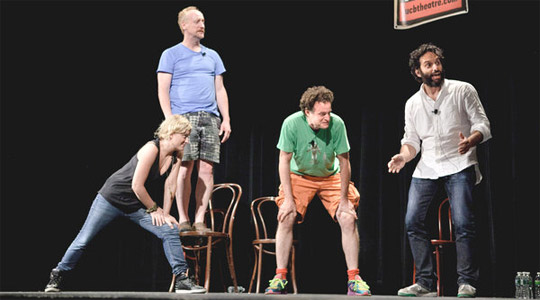
Specifically, longform improv comedy involves actors cooperating to "find the game" -- to find the core of a joke. Each actor makes "offers" to expand upon a premise and move action forward, hopefully toward a funny destination, and usually, actors err on always accepting offers ("saying yes") and building upon it since "blocking" offers frustrates your scene partners. However, it's very possible to "say yes" to a premise while still "blocking" the "game."

Here's an explanation from an NYC improv comedy personality, Will Hines:

Thursday, February 14, 2013

Approaches to game development education.

I'm currently teaching a Unity class at Parsons called "Building Worlds" -- and I'm treating it as my opportunity to get everything right and Solve All Problems in Game Dev Education... Obviously, the reality of the class is much more complicated, and ambitious teaching philosophies never really survive a semester intact.

But before I become bitter and jaded, here are the main principles / pillars I'm starting with:

0) Game development is not game design. The former concerns process, implementation, and engineering, the latter is the art of theoretically abstracting behaviors and relationships into something compelling.

1) Breadth. Everyone should know a bit of every aspect of game development, a "liberal arts" education in all facets of development, and everyone should be able to make a game entirely by themselves. All developers should have basic drawing / modeling skills, basic coding skills, and basic design skills. Of course, everyone has their specialties and interests, but the goal of game development education should be to produce independent, T-shaped developers who can see the big picture and collaborate when they need to. Don't specialize too early.

Saturday, February 9, 2013

On Limits and Demonstrations, and games as conceptual art.


This is a sort-of-review about Limits and Demonstrations, by Jake Elliott and Tamas Kemenczy. It gets just a little spoiler-y, but not in a way that'd seriously compromise your enjoyment.

Most people play chess with pieces and a board, but to many players that's not the actual game -- it's just a mnemonic aid, a thing that keeps track of chesspiece locations so you don't have to remember where your rook is. The people who live and breathe chess, however, can play chess just by reading chess notation in a book, which is to say that the game takes place entirely in their minds. This is more or less what happens when you lose a heated multiplayer match of Starcraft and agonize over what you could've should've didn't do, and wonder what alternate paths you might've taken. Likewise, I'd imagine the most skilled Starcraft players can play Starcraft entirely in their minds.

It's not just in games either: Beethoven was deaf but he could imagine the notes and harmonies so well that it didn't matter, and a Chinese concert pianist was jailed for 6 years but stayed skilled by "practicing in his head."

But I think game designers, designing games directly as a form of conceptual art, is still a relatively new thing.

Thursday, February 7, 2013

A smoother triplanar shader for Unity.


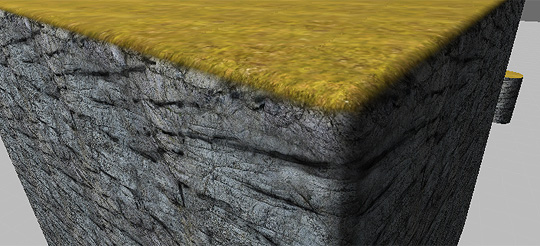
To review: procedural UVs are amazing and you should consider using them in your games. Now, the old triplanar shader I posted was great at hard-edged cubes, but it didn't handle the transitions between textures very gracefully; curved surface like cylinders and spheres were forbidden.

So I took a look at how James "@farfarer" O'Hare handled the blending in his triplanar terrain shader, and how Tom "@quickfingerz" Jackson grabbed normals in his own triplanar shader (but the blending in his shader would "blow-out" a lot, I found) and I combined their respective strengths. I also added different handling for top vs. bottom textures, since grass rarely grows on ceilings. (Textures in the shot above are from Farfarer's pack.) One last change: I let Unity's built-in surface struct calculate world normals instead of calculating my own.

So far, I've been unable to get normal maps working with it, so if any enterprising blog readers would like to instruct me how to do it, and share that technique, then I'd be much obliged.

Here's my shader so far. Do what you will with it:

Sunday, February 3, 2013

Narrative systems workflow; using Fourier analysis and level design metaphors to systemize stories.

This assumes familiarity with Shakespeare, a procedurally-branching narrative system that I'm designing. For an overview / introduction, read "More talk, more rock."

I started by arguing that interactive fiction's narrative systems expose too much complexity and detail to its authors and players, or at least more than most people need or want. With Shakespeare, I hope to achieve just a fraction of that functionality, and I think that fraction is enough to be very compelling while facilitating a writer's work.

In engineering Shakespeare, I think of the system in four parts:
a) The real-time system that runs algorithms, interfaces with the game as the player plays.
b) The data / format of narrative itself, how it's structured.
c) The Unity editor interface for generating, editing, or creating the narrative data.
d) The suggested workflow / instructions for using that interface.

Now that I have enough of a base implemented, I'm starting to think more about that last part, the operations design. Roughly, I think the tool could work like this:

Friday, February 1, 2013

My Spring 2013 at Parsons

This semester at Parsons, I have two things going on:

1) I'm teaching an undergrad / grad studio elective course.

Currents: Building Worlds was originally pitched as an "introduction to Unity" class, but then the administration said that Parsons never conducts purely "software" classes. They suggested teaching Unity through some sort of theoretical lens -- and the class design is probably much better for it. So now, it's kind of an intro to Unity / C# / working with expressive 3D / architectural theory class, and it argues for "3D" as a unique expressive medium in itself. There's also a strong focus on discussing "behaviors" theoretically, and how to combine simple behaviors to produce some sort of emergence... whether that's what constitutes a "world." I think I'll assign a chapter of 10 PRINT as a reading? (The "Currents" prefix is like a disclaimer -- "This course is an experiment. Take it at your own risk.")

2) I'm also a "consultant" / aide / "technologist" on another course, taught by Colleen Macklin / John Sharp / Heather Chaplin.

Datatoys is a collaborative class between journalists and design students to re-imagine journalism as a toy -- to turn data into interactive systems that demonstrate patterns of behavior. "Let's face it," began the journalism professor, "reading the New York Times is really boring. Print journalism is dying. Now, what is the journalism of the future?" What are the politics inherent in toys and play? How do we reconcile that with the ethics of journalism? If play is independent and unstructured, does that resemble how journalistic objectivity is independent? Can players act as journalists? How and when do toys lie?

The multidisciplinary nature of these two courses is what makes them conceptually strong and compelling, yet also very difficult to realize into actual designed things... But if they were easy, then they probably wouldn't be worth doing.

Saturday, January 26, 2013

More talk, more rock: on algorithmic game narratives, speculative narrative design futures, and "Shakespeare."

by Nexus

Last time, I wrote about procedural narrative in the context of "process intensity." Here, I expand more on designing the procedural / process part.

Back in an expertly-conducted 2011 Rock Paper Shotgun interview, Dan Pinchbeck argued that game development culture unnecessarily separates narrative from the rest of a video game:

"I just want story to be talked about as a gameplay element that sometimes isn’t there. It’s part of the set of tools that a game designer uses to create an experience – and it should be thought of along the same lines, as physics or AI or something more mechanical."

We have physics engines or texture libraries, so why don't we think of narrative as a modular "asset" or "engine" or "library" to be swapped around as well? Why can't narrative be more "mechanical." Where's all the narrative middleware? (Storybricks doesn't seem to be doing too well, unfortunately. I also don't agree with them, that proc narrative is mainly an AI problem...)

Tuesday, January 22, 2013

Devlog: "Conanbowl"

(lighting / color test with random NPC mobs)
Me and Eddie decided we should make a game this past / current weekend. It started with our usual process: clicking "random page" in Wikipedia until something strikes us. This time, we were struck by "The God in the Bowl," a Conan the Barbarian short story where Conan has to solve a murder (?) when he's actually there because he wants to rob the museum, but then a ghost kills a bunch of people?

Anyway, this concept resonated with us: an adventure-ish game where you must steal things and solve a case; you're a kleptomaniac detective in Victorian-ish London, and you're assigned to cases where you're actually the thief.

Or something like that.

Thursday, January 17, 2013

2/3

At some point, I think I forgot I was making a game. It became more like this expansive simulation of every possible reality, folding into itself; I caught myself wanting to make everything interchangable with everything else, to let every piece talk to another piece and act like yet another. Everything was a network, a graph, and every node was another network. Recursion upon recursion.

There's a tendency in game development to think that you will always be coding "the" framework you can re-use and re-use for everything. Everything should be modular, endlessly recyclable, endlessly useful. It's hard to let that go and accept that you should focus on making a game, first -- a game that works -- and not an engine or a library or something that'll change everything as we know it. I ended up forgetting the most basic lessons of making.

Convo felt too big, and it felt too big by 2/3. I had to cut 2/3. I don't know how I can quantify a fraction like that, but I thought about my ability to build and engineer and develop, within the timeframe I wanted, and decided it was overextended by at least 2/3. I've cut a bunch of stuff, but I'm not sure if the scraps on the floor -- do they add up? Is it enough? How do you know if you've cut too much? Is this what Peter Molyneux feels like?

More details soon...

Saturday, January 12, 2013

The unportalable: games as paratexts and products


Several years ago, I sat-in on a "games as literature" course, and promptly got into an argument with the instructor. We were talking about Portal, and he argued the dark metal unportalable surfaces seem "sinister" because of their color, rustiness, sense of alien materiality and permanence, lack of affordance, etc. (This was also an introductory course, so a lot of his effort went towards getting students to make critical arguments about games at all.)

I argued that interpretation was irrelevant, and that type of thinking was obfuscating how these surfaces actually function to players: in Portal you don't think to yourself, "that wall is scary," but you more often think "I can't portal there, let's look somewhere else" or "wow that wall looks cool on these graphics settings." To me, the wall material told more of a paratextual story rather than a diegetic story.

Tuesday, January 8, 2013

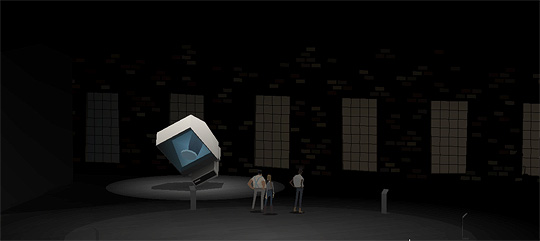
Kentucky Route Zero (Act 1), by Jake Elliott and Tamas Kemenczy


The first act of Kentucky Route Zero is now available for purchase, conveniently on the same day as the news that it has more or less swept this year's IGF nominations. The praise is well-deserved. Cynically, you could sum it all up as Sword and Sworcery + Prairie Home Companion + the love child of a Jorge Luis Borges / David Lynch / Flannery O'Connor threesome (except, uh, less violent). It is a game consisting almost entirely of moods.