Thursday, July 10, 2014

"Keys" by Ryan Trawick, and the emerging shape of post-mod culture and walking simulators


Keys is a newly released single player Source mod, made mostly by Ryan Trawick, that is freely available to anyone with a Steam account.

... Which is made possible by Valve's generous licensing of their Source SDK 2013 Base. This is kind of a big shift in policy for Valve. Historically, mods have been locked to their parent platforms so that they could drive-up sales of triple-A retail (e.g. people buying Arma to play the original Day Z, or Warcraft 3 to play the original DOTA), but something here has changed. Perhaps Valve has decided they have enough money, or perhaps they realized Steam is already a powerful platform to lock-in people anyway. So now, Source 1 is kind of transitioning into more of a middleware platform like Unity or Unreal, though most people outside of the TF2 / CS:GO communities have generally moved on already.

What are Source mods in a "post-mod" age, where they're not even modding a retail game anymore, and they're freely distributed and shared? Can we even still call these things "mods", or have they transcended that type of framing?

Thursday, July 3, 2014

Game engine review roundup

Unreal Engine 4. Very good high-end support, integrated vertex-painter, great for making 3D shooty games in huge landscapes. But it's very heavy and assumes you're making a 3D shooty game in a huge landscape, and it feels very bloated if you're not. 7/10.

Unity 4. Good medium-weight engine, with very few game genre assumptions. But that flexibility turns into tedium when you have to re-implement NPC AI / basic movement / damage systems / camera controls / etc. for the hundredth time. Very bad stock controller and GUI support. 7/10.

CryEngine 3. Very good high-end support that assumes you're making a 3D shooty drivey game in a huge landscape surrounded by water. Fantastic foliage and rock placement tools that are useless when that's not what your game's about. 7/10.

Source 1. The 2000-era engine that has aged the best, with its smart bets on image-based rendering and lightmapping. Physics feel tuned so well that Titanfall used the engine pretty much for that. However, has a horribly bad 3D asset pipeline that forces artists to learn an obscure "Quake C" syntax from the early 90s in order to import art -- which, in a 3D engine, is totally inexcusable. 7/10.

Twine. Best-in-class text support, exports seamlessly to all platforms, very little technical friction and learning curve. Very diverse and helpful user community. But text markup scheme feels patched-together and inconsistent, requires users to learn Javascript (?!) for more advanced features. No built-in 3D or multiplayer support. 7/10.

Friday, June 27, 2014

Nostrum and "strategic retreat" into conversation analysis

So I was reading some of the Versu design papers and suddenly it hit me: they're doing a lot of the procedural narrative stuff that I want to do, and yet, their magnitude of systems complexity and authoring was still way too much for what I needed (or could feasibly engineer) for Nostrum.

I am now issuing a "strategic retreat" to all departments and agencies here at Radiator: we're going to leave "strong" procedural narrative alone, and pursue a different model for NPC simulation.

For this new approach, I'm digging up another old idea I had: to think of conversation as the exchange of information. For this, I'm leaning heavily on "conversation analysis" theory from linguistics...

Friday, June 20, 2014

Someplace Else source files (for Black Mesa Source) + "Majestical" env texture set


A year and a half ago, I was working on a Source re-mastering of Adam Foster's classic "Someplace Else" to plug into Black Mesa Source. The appeal of modding a mod to remake a mod was intoxicating. Unfortunately I haven't really touched Hammer since then though, so I think I'm now forced to admit that I probably won't get around to finishing it.

I am open-sourcing the map file and textures I made for it in hopes that maybe someone more motivated can pick it up. If you're interested in finishing what I started, here are some design notes:

Tuesday, June 10, 2014

Noserudake 2 and the language of development


Noserudake 2 is a fantastic Unity browser game where you balance things on a platform. It is also the sequel to Noserudake 1, and the Japanese developer's changes between installments are telling.

They gave the player direct control over rotating the dais, they enabled real-time shadows and textured the dais to give more depth cues, and the physics objects have been well-tuned to be more forgiving and have more weight and heft. Also, the slapstick shift between level 4 and level 5 is pretty brilliant, a joke through level design that transcends language barriers. But one of the most glaring new changes in Noserudake 2 is that the developer has added English translations alongside all the in-game Japanese text. The developer is clearly conscious that they also have a Western anglophone audience following their work. But why are they accommodating us?

Thursday, June 5, 2014

I'm nicer in person, honest

There's a profile of Harry Lee / Lost Levels in Polygon, and I'm quoted heavily, but kinda as more of the crass anti-corporate provocateur foil to Harry's deeper philosophical positions.

(Which is obviously just a writerly device because hey, I work for NYU, considered by some to be one of the most destructive forces against public education and local communities ever imagined. I'm a fucking sellout! Though I guess I was asking to be cast that way, especially when I gave that soundbite that the Ken Levine talk was boring. But it's okay if it was boring, because the purpose of booking Ken Levine was to sell tickets and introduce people to basic questions in procedural narrative. Does that make it a good talk? Roger Ebert would've said yes, because it did what it was trying to do; I would say no, because we should always make higher demands of discourse.)

(Anyway.) I think I'm okay with playing that role in the article, because it gets the point across that there's more than one agenda and Lost Levels isn't one particular thing. I just wish more agendas got more represented in the article: like Harry tweeted, Mattie Brice, Toni Pizza, and Ian Snyder, are Lost Levels co-facilitators who deserve credit for their valuable work, and it's as much their stories (and everyone who came to the event!) as ours.

Also, I think much of my criticism on GDC in the piece (e.g. it's expensive and the expensive talks are rarely good) orbited around one main point that got only paraphrased briefly in it:

Friday, May 30, 2014

Spring 2014 quarterly progress report

A progress report on "small" projects:

"Intimate, Infinite" is 80% done, and it's for the Series pageant at makega.me. It will be done soon. I've kinda surprised myself with how much I'm putting into it, so I think I'll sell it for pay-what-you-want.


"Vaquero" is about 50% done, and it's for the Space Cowboy Game Jam. It will probably be done soon.


"Peon" is about 50% done, and it'll be a larger project for most of June, alongside prepping Nostrum for exhibition at GaymerX2.

Wednesday, May 21, 2014

Notes on discontinuity and interiors in open world games

To enter a different level in Thief 4, you frequently have to mash [E] to pry open glowing windows (or lift fallen wood beams) as the game "seamlessly" loads the next level in the background. You will see this screen a lot.
An "open world" is a marketing tool / level design structure where the game world is gradually loaded or "streamed" as you explore it, so that it seems like one large long continuous level. In many respects, this continuity is an illusion; the game developers built the world in chunks and the game engine thinks of the world as chunks, but players experience the chunks as they're stitched together. It's an immersionist fantasy -- of no loading screens or progress bars, of seamless transitions between worlds.

But as I mindlessly mashed the [E] button on my keyboard for the 30th time to enter a different level in Thief 4, I realized that (a) this is a really bad attempt at hiding load screens, and (b) I tolerated the (brief but just as frequent) loading screens in Skyrim much better because those are honest about what they're doing. A loading screen unambiguously signals discontinuity to the player, a break between parts of the world. An open world overworld can only exist if there's an underworld beneath it, and I argue that it's okay (or better) if you clearly mark the borders because it's okay if we stop interacting with a game for a second.

When do open worlds choose to be discontinuous with a menu, loading screen, or lobby? When does one wait to "enter" an interior, to voluntarily break the flow of play?

Wednesday, May 7, 2014

DECK (Doom Engine Creator's Kit) needs artists and sound designers.


JP LeBreton has recently announced the "DECK" (Doom Engine Creator's Kit) project, an open-source public-domain all-in-one bundle of Doom technology: a game engine + editor + game assets + tutorials, all integrated together and easily accessible. It's intended to empower people to easily make cool lo-fi 3D first person games and it sounds really cool...

... but it needs help. It needs some Doom-style character sprites, some Doom-style environment textures / decoration sprites, and a lot of audio design. Pitch in and help build free indie game tools!

Here's my contribution so far, some painterly-ish pseudo-photo "medieval manor" textures:


It was kind of fun to work at low resolution without having to worry about shaders or 3D meshes or UVs or whatever. I recommend it.

Sunday, May 4, 2014

"SERIES" is the first MakeGa.me pageant theme!

"We make game, do you make game? MakeGame is a place for you to show some similar-minded folk what you're working on. Get feedback, discuss design problems, share inspirations. Every couple months we host a pageant. A month-long 'slow-jam' where we all make games to explore a chosen theme. Welcome!"
MakeGa.me is a new game development forum from the ashes of the former Super Friendship Club. A lot of the original guiding principles remain: to learn from each other and help each other make great work. To help motivate each other, there are monthly "game pageants" -- a game jam-like that de-emphasizes winning or losing. Ian Snyder's organizing the first one, focusing on the idea of a "series"...
"Instructions: Make a two or more small games all revolving around one central theme or idea that when taken together form one cohesive whole. Make the games good. For examples of this in other media, you might look to Thirty-Six Views of Mt. Fuji36 or Thirteen Ways of Looking at a Blackbird30 or [if you have other examples or items of inspiration, reply below!]

Starts on May 1st, finishes on May 31st. You're welcome to enter any media you prefer, games or not. Disobey any instructions, or follow them rigorously. If you haven't made games before, and aren't sure where to start on the technical side of things, just ask : there're plenty of people here who can give guidance."
Full briefing is here. Looking forward to seeing you all over at MakeGa.me!

Thursday, May 1, 2014

Get Better Soon, dev diary #4: conceptualizing input in virtual reality.


This is a development diary series for "Get Better Soon", an NEA-funded gay club VR simulator game I'm making for Different Games. You can check out previous dev diaries here.

Virtual reality is weird and terrible for a lot of reasons: "simulator sickness" is the frequent sensation of nausea that attacks many players, simply from trying to exist inside virtual reality. (There are lot of complex reasons why that happens.) There's something fascinating about that -- a reality where existence makes you want to throw-up. A lot of that bizarre beauty is going to get smoothed-over and destroyed as the technology improves, which is unfortunate.

One of the more upsetting developments in VR progress is the specific user flow and use-cases that the two biggest VR influencers (Valve and Oculus) are prescribing for VR games. They imagine every VR user is going to be seated in front of their computer, with a positional tracking camera on a desk in front of them. The idea is to seat the player so they always know which way is "forward" by their dead reckoning, which simplifies how head tracking will combine with controller or mouse input. That way, it matters less whether you're blindfolded with a screen strapped to your face.

I think this is kind of a conceptually lazy way of solving the "input" problem.

Wednesday, April 23, 2014

Some dogmas I perpetuate

  • When the player does a thing, there should be some possible reason why or situation when they would NOT do that thing. Unless you specifically want it to not matter because ____.
  • When the player does a sequence of things, there should be a reason why they did it in that sequence vs. a different sequence. Unless you specifically want it to not matter because ____.
  • Things should feel embodied / have "feel" and feedback to them, according to how important they are to understanding what's happening. Unless you specifically want players to not notice it sometimes because ____.
  • Your game should occasionally be a little boring, or occasionally be a little exciting. This is called pacing.
  • Make the smallest possible game you can make. You can always make it bigger later. Each prototype / iteration is a different game.
  • Don't implement most suggestions that people give you. Think more about why they made those suggestions. Also, don't be upset when a dev ignores your suggestion, you're not the one making their game.
  • Don't plan too far in advance. Your plan is going to change anyway.
  • When tuning, double a value or halve it or increase / decrease by magnitude of 10 or randomize it.
  • How you talk about your game affects what your game actually is.

Wednesday, April 9, 2014

"Get Better Soon" dev diary #3, skin and light iterations


This is a development diary series for "Get Better Soon", a commissioned game I'm making for Different Games 2014. If you want to see it and play it, then come hangout at Different Games next weekend in NYC!

Kris Hammes is finishing up the character. The 3D model geometry is basically "done" so now I'm just waiting for the last texture tweaks like chest hair. In the meantime, I've rigged the model with a standard "HumanIK" skeleton in Maya (so that I can easily re-target animations in Mecanim) and I've configured the shader so I can start figuring out how to implement these characters into the game.

Wednesday, April 2, 2014

Second time's the charm; procedural NPC dialogue in Nostrum


Last time I tried some type of "procedural narrative" thing, my hubris got the better of me -- naming the system after one of the most famous and influential writers of all-time was, perhaps, just a little arrogant.

Despite my attempt to scope it properly, that system suffered greatly from trying to do too much stuff... It was so much stuff that it was difficult for me to write anything with it. So with the procedurally generated NPCs in Nostrum, I'm developing a much simpler system which will hopefully work better, to solve a smaller problem...

The basis is still the same: Elan Ruskin's GDC 2012 presentation on AI-driven dynamic dialogue in Left 4 Dead 2.

Tuesday, March 25, 2014

This is what I'm working on, March 2014

What are you working on? This is what I'm working on:

"Get Better Soon" is a VR-powered gay clubbing simulator haiku. Imagine a universe where EA invests heavily in sexualizing men using the latest in DirectX technologies... throbbing, pounding, pulsing bodies -- a perpetual shower. Nothing in the voice of the cicada intimates how soon it will die. A commission for Different Games, made possible with funding from the National Endowment for the Arts.

"Charity" is a procedurally-aided Thief-like set in Ciudad, a vast 13th century Moorish boomtown slowly sinking into the ground. You're a "placer", a freelance thug, an alchemist -- you beat people up and turn blood into money. Will you side with the environmentalist royals, the all-consuming corporation, or the industrial workers of the world? Underground we fought the earth together. Inspired heavily by the high-profile failure of Thief 4.

"Nostrum" is a VR-ish roguelikelikelike life simulator about just war theory. You're a freelance pilot based in the Mediterranean Sea circa 1936... well, you would be, if the Fascists would just quit killing your business with all these silly airspace regulations. Over several years you will befriend several islands' worth of alligators, corgis, giraffes, zebras, and more -- and then watch their homes burn. It's Animal Crossing meets Animal Farm, and you're just the small business owner caught in the middle? The first video game ever made about World War II.

"Radiator" is... I don't even know anymore.

Saturday, March 15, 2014

GDC 2014 Dance Card

Are you in San Francisco next week? Here's some stuff you could do:
  • Critical Proximity, a free mini-conference where game critics mingle and grouse... productively? There's a pretty diverse lineup of speakers here -- non-critics, critical bloggers, academics, developer-critics -- and, uh, Ian Bogost?
  • Unwinnable Party, a bunch of games people invade High Tide, a (very) divey bar in the Tenderloin. As far as dive bars go, it's a pretty good dive bar, though.
  • Agency Launch, basically an excuse to hangout with people (or play Netrunner?) while sipping somewhat pricey drinks in the "Death Star bar" (you'll understand) overlooking downtown San Francisco.
  • The gay game industry group is hosting a night at The Stud bar, which is probably one of the more inclusive gay bars in the city. The first 100 drinks are on them.
  • The annual Wild Rumpus party at Public Works, one of the few times when people actually dance. Good game curation too, and within a few blocks of burrito mecca down Mission St. (or hipster mecca on Valencia St.)
  • Lost Levels is a free picnic unconference where anyone can give a talk or run a session. Bring a lunch and hangout!
  • TIGSource regulars usually invade the local Denny's (on Thursday or Friday night?) for a mini art / work jam. I strongly recommend a "Moons Over My Hammy" sandwich or an Oreo milkshake.

Tuesday, March 11, 2014

Course catalog at Radiator University, Fall 2014

If I had a university, these are some of the courses I'd run:

PE822 -- CS:GO SPORTIFICATION INTENSIVE (2 units, Detroit campus)
In 1999, Counter-Strike changed the face of multiplayer shooters -- sci-fi gothic fantasy died and "realistic" squad maneuvers became the dominant discourse. The series then languished until 2012, when Counter-Strike: Global Offensive triggered a renaissance in player and level design theory. In this studio intensive course, we will critique this development history and "sportification" of the series while iterating on small levels designed for public and competitive play. (PREREQUISITES: Sculpture I, War Crimes seminar, Basketball II or higher.)

KL72 -- MAKER MAKER (3 units)
Tools like FPS Creator or RPGMaker bring new blood into development communities while manifesting structural critiques of game genres. If something is difficult to do in RPGMaker, can it be said that RPGs should generally not implement that feature? How do the workflows and "grains" of our tools affect our abilities to make things? This course argues that making a new generation of "maker" tools, grounded firmly in new genres, is imperative for articulating a new praxis of game development. (PREREQUISITES: at least 1 linguistic determinism seminar.)

R20A -- COLLAB WORKSHOP, "PERVASIVE ARGS" (2 units, Montana campus)
The "magic circle" refers to the idea that many games clearly demarcate the boundaries between players and those not playing -- e.g. you must be playing a game in order to score a goal, otherwise you're just some person kicking a ball on a grass field. Taking cues from David Fincher's thriller "The Game" (1997), we will act as "puppetmasters" to construct elaborate "alternate reality games" that surround / swallow our players' lives, blurring the line between playing and living. (PREREQUISITES: Metalworking II, Improv Studio 201, and/or equivalent professional experience)

E100 -- ENGLISH 1
Writing expository, analytical, and argumentative essays; developing critical reading and research skills. Review of sentence structure and grammar.

Sunday, March 9, 2014

"Get Better Soon", dev diary 2: character art and production value.


This is a development diary series for "Get Better Soon", a commissioned game I'm making for Different Games 2014. If you want to see it and play it, then sign-up to attend Different Games in April in NYC (for free!)

Bodies, much like video games, are routinely commodified -- there are "cheap"-looking and "expensive"-looking bodies. Society devalues and discriminates against certain body types, while affording privileges to other body types. We read video games in much the same way, based on the shape of the game's body... the packaging and production values, and/or "paratext", of a game. Production values are a relatively quantifiable way to impress people and convince them to pay $60 USD for a set of mechanics that have remained virtually unchanged for decades.

What if "queer games" weren't popularly characterized by the do-it-yourself gumption of personal stories, expressed predominantly through webpage text, by artists with few resources? What if Electronic Arts directed their next-gen AAAAA commando-developer divisions to build big budget romantic comedies about time-travelling transgender witches who critique Foucault?...

Monday, March 3, 2014

Sophie Houlden teaches you what 3D normals / "normal maps" are... with lots of pictures!


The indie developer Sophie Houlden has posted a great visual explanation of what "normals" are, within a 3D video game art context. Full explanation is after the jump:

Tuesday, February 25, 2014

#lostlevels 2014

Me and my fellow co-organizers have announced another incarnation of Lost Levels this year, happening on March 20th in San Francisco. Lost Levels is a casual community-led "unconference"-style picnic that we put together because we think large conferences are good at some things but bad at other things -- maybe Lost Levels could help with those other things? We believe in "radical inclusion", which we try to implement by being completely free with an open submission process.

This year, we are anticipating more people, so we've gone to the effort of acquiring an event permit. (Our venue requires us to get a permit for gatherings larger than 25 people.) We're getting the permit to protect everyone and minimize possible conflict. However, the permit is expensive; combined with the event insurance costs, we are spending more than $3000 on fees alone. If you can afford it, please consider donating.

None of us have much money, so any assistance is appreciated. However, I want to be clear -- we will run Lost Levels no matter how much we raise because we run Lost Levels for you, not for us.

If you'll be around San Francisco, we'd love to see you there -- and we'd love it even more if you gave a short talk or ran a short discussion group or did a small performance. Please sign-up to attend or submit session proposals! (We are especially fond of the weird, the unusual, and the silly.)

Sunday, February 23, 2014

A first-time IGF judge with IGF submission advice... and why the IGF doesn't matter?

This was my first year being an Independent Game Festival judge. As an IGF entrant in the past, I found myself confused and frustrated with the judging process. I've realized that a lot of the frustration came from not knowing how the process worked.

(If you're still frustrated with the IGF, though, that's fine. Say so! That's how it gets better.)

Friday, February 14, 2014

"Game Educators Rant" at GDC 2014

At this year's GDC in San Francisco, I'm going to be delivering a rant as part of the "Game Educators Rant" session.

I'm still working out the script and details, but it's generally going to expand on what I've said before -- that game development has a sociopolitical dimension, and developers should actively recognize it and work in this dimension.

It should be an interesting session overall, considering that my esteemed colleague Sarah Schoemann will be delivering a rant opposite mine, arguing against the essentialism of learning code and technical development. Bring it on!

Monday, February 10, 2014

An alternate history of Flappy Bird: "we must cultivate our garden."

As a pseudo-academic in games, I worry a lot about what will "make it" into "the history" of video games and what will be deemed culturally significant enough to study.

The latest spectacle with the game "Flappy Bird" will either be (a) universally forgotten by next week, or (b) it will be the peculiar subject of some student's thesis paper, or (c) it will live as a game culture touchstone that gets invoked frequently for the next few years. Even though it's least likely, I'm writing this post for case B: it may be a somewhat obscure thing that gamers discuss once a year, or that games academia instructors will mention casually to their students, and maybe the students will dutifully google it and wonder what happened Back Then...

Now, because I can't tolerate the idea of Kotaku's misleading titling or Eurogamer's barely-researched and contentless coverage (among many others) of Flappy Bird, marching unopposed into the chronicle of internet history -- I hope this blog post gets indexed and listed on the 3rd or 4th page of "flappy bird game history" search results or something. If you're writing a game studies paper on this, maybe put this paragraph under a patronizing header like, "Other Perspectives?", or at least give me a footnote and imply you read this. Thanks.

If you're reading this in 2015 and no one remembers what Flappy Bird was, then I want to emphasize one thing:

In February 2014, there was not much controversy for many game developers, especially indie game developers -- the internet was harassing Dong Nguyen for making a game, which is unacceptable. Many people do not support how Nguyen has been treated, and have said so. It is always important to remember resistance to a mob.

Friday, February 7, 2014

re: "Possibilities and Pitfalls of the Video Game Exhibition"


In "The Possibilities and Pitfalls of the Video Game Exhibition," Nicholas O'Brien talks about his experience in attending game exhibitions at Museum of the Moving Image and the Museum of Modern Art in New York City and finding their curation and installations lacking -- specifically, they don't afford visitors interacting "properly" with longform single player games, because the self-awareness and performance of a museum context means you will never really engage with the game.

A couple years ago, I was of the same opinion and I even complained about the same institution, and now I'm surprised that I've changed my mind and I find this opinion kind of short-sighted...

Sunday, February 2, 2014

"Get Better" dev diary 1, idea and notes

I just got news about an arts grant that I was part of -- and it turns out we now have some funding! Hurray! I'll talk more about those details when the exhibition organizers announce it, but for now, I want to start documenting my process in making this game -- which I am tentatively calling "Get Better" as a direct challenge to the rhetoric of the mainstream gay-industrial complex.

(Well, originally it was called "Ludonarrative Disco-dance." But that makes it sound too much like a game about games, and this game isn't primarily about games.)

In terms of actual prototyping and production, I'll probably be building on top of my existing first person framework, but I haven't actually done anything yet. Mostly, I've been sending e-mails to possible collaborators and contractors. (The small chunk of arts grant money is making the asset contracting possible. Yay for having a budget and paying people for their work!)

Instead, I'm trying to sketch out the structure of the game first. So here are my actual game notes, along with some remarks on my notes...

Monday, January 27, 2014

The land of milk and honey

Some brief moments from New Zealand. We now return to our scheduled programming...

Thursday, January 9, 2014

"Black Mesa Source: Makeover Xtreme" at Indiecade East 2014

Indiecade East in New York City is happening in... about a month... and I'm giving a talk there. (A talk that I should start writing. Shit.) I should also note that the entire speaker lineup is very exciting and diverse and Indiecade is a lovely games event with a very good signal-to-noise ratio.

My talk continues the "technical politics" theme of my other talks these past few months:

"Makeovers are serious business. That's why dozens of modders volunteered to makeover Half-Life 1 (one of the most influential games ever made) in a new game engine with new graphics, architecture, animations, voice acting, choreography, sound effects, etc. So much work goes into the video games we play, but what exactly does that work involve? Get ready for excruciating detail about the blood and sweat that goes into just one room of one level of one game -- and why us modders w-w-work it for years to give it away for free. See? Makeovers are serious business."

My relationship with Black Mesa Source is strange -- I did a lot of work for them for a few years, then left because I couldn't commit time to it anymore -- so I recognize a lot of the content, but at the same time it feels somewhat alien to me because someone else finished it.

There's something interesting to dissect about the identity of work, here, especially given the intangible status of mods.

Are mods "games"? In terms of distribution / ownership / sales, no. In terms of artistry / concept / craft, yes. Is this Black Mesa Source level mine? Yes and no. When you get a makeover, are you still you, or someone else? What are the politics of makeovers? etc.

Wednesday, January 1, 2014

New year's resolutions, 2014

I am going to finish Nostrum and sell it.

I am going to finish Radiator and release it for free.

I am going to finish my Someplace Else port for Black Mesa Source.

I am going to finish a substantial draft of my Half-Life book.

I am going to write more about individual indie games instead of complaining about Bioshock Infinite.

I am going to be better about work / life balance.

Tuesday, December 24, 2013

Radiator Blog: Four Year Anniversary


This year marks the Radiator Blog's fourth year of existence. It's now ready for preschool, wouldn't you say? (They grow up so fast.)

Much like the first, second, and third times I did it, here's a "best of Radiator" list for 2013 along with some brief commentary -- and please eat some of this cake, forks and plates are on the table behind you.

Friday, December 20, 2013

PRACTICE 2013 "Well-Made: Back to Black Mesa" talk video is now online.

So I gave a talk on Half-Life / game development at PRACTICE 2013, and the video is now online with a fancy title card and everything. Thanks again to NYU Game Center for hosting and having me!


Well-Made: Back to Black Mesa

The modern AAA single player first person shooter consists mainly of two things: shooting faces in implausibly realistic levels with a pistol, machine gun, shotgun, sniper rifle, or rocket launcher -- and obeying NPCs when they trap you inside a room so they can emit voiceover lines at you. Half-Life's legacy in the latter is well-mythologized in history, but what if we re-visit Half-Life as a masterpiece of technical design, enemy encounters, AI scripting, weapons tuning, and architecture? Spoiler: we'll find out it's a pretty well-crafted game.

To learn more about PRACTICE, visit http://gamecenter.nyu.edu/practice

Friday, December 13, 2013

Untitled co-op Wild West boomtown management game that is populated entirely by stray cats


Me and Eddie were wondering what to play. We can't play competitive games because we end up getting too upset at each other, so we usually need some sort of co-op game. However, there aren't that many co-op strategy games out there, or at least ones that are lightweight enough. Then we thought -- if we're game developers, we might as well just make the game we want to play, right?

Also, did you know: Unity particle system can emit particles based on any mesh, not just flat billboard quads?

Monday, December 2, 2013

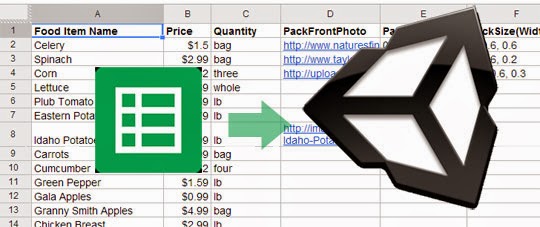
Reading public Google Drive spreadsheets in Unity, without authentication


I'm working on a project with a collaborator who doesn't use Unity and doesn't really have an interest in game development (gasp) but it is still important that she can add/edit item data for the game. From a practical workflow perspective, I probably would've kept the item data separate from the game code anyway, to make it easier to balance and tweak stuff. This is usually the stage at which you'd make your own level editor or game database editor or something, but maybe there's a better way -- we can just tell Unity to read from a public Google Docs spreadsheet and parse the data. That way, anyone can edit the game levels or localization strings or whatever from anywhere in the world, and the game client will update data seamlessly.

A lot of this post comes from Clark Kromenaker's great post on accessing Google Docs services with C#, and a lot of my setup process is the same as his.

However, my particular project didn't need any data kept private, the game itself didn't need write access to the documents, and authentication looked like a pain (e.g. using OAuth 2.0 requires you to open a browser window so the user can okay the permissions? Yeah, no thanks) so I worked out how to access read-only publicly published Google Drive spreadsheets without any logins or anything.

Tuesday, November 26, 2013

"Well-Made: Back to Black Mesa" @ PRACTICE 2013


Very special thanks for Frank Lantz for inviting me to speak, and to Charles Pratt / Kevin Cancienne for counsel and emotional support, and Brendan Keogh / Dan Golding for convincing me that people even want to hear about stuff like this. Many of the ideas in this presentation will be expanded upon for the book I'm doing with Press Select.

First I want to set the record straight: I love Half-Life, but that doesn't mean it's immune to criticism. It is flawed in many ways. (Hard mode is too hard. The game is too long. On a Rail induces hemorrhaging. etc.)

I also think games mean things so far as you can argue for certain interpretations -- and I think Half-Life's popular legacy does not endure much scrutiny. Specifically, Half-Life's narrative is not subtle nor sophisticated nor conceptually innovative: from what we know about its development history and acknowledged inspirations, it is designed to be a schlocky silly action B-movie about a sci-fi disaster conspiracy, and I argue that reading is more convincing than thinking it's "the Myst of video games" or something.

That does not mean a schlocky game is bad; schlocky games are often fantastic. What I'm arguing, instead, is that many players prefer the weaker reading of Half-Life because they are seduced by the promise of technology without actually understanding what the technology is doing. Half-Life is magical and interesting and subtle, but not in the way that gamer culture mythologizes it. (At the same time, let's still be critical of what Half-Life does, and the values it represents to both players and developers.)

Wednesday, November 20, 2013

PRACTICE 2013 post-partum


This year, I gave a talk at PRACTICE (more on that later) and I had a pretty good time in general. I think now (a) I am slightly more patient with board games (b) I love Nordic LARP even more (c) I have more respect for the depth of thought that goes into a lot of games that I will never ever play ever. Someone asked me what I thought the overall theme of the conference was, and I think a lot of it was about game developers honing our "awareness" of each other. The schedule was diverse:

Saturday, November 16, 2013

Games without gamers; imagining indie game developer futures


Indie developers think about money a lot, and whether game development can sustain them. If you've managed to make a good living with selling your game on Steam, that's great and I'm happy for you. Now what about the rest of us? What if a game developer can have a different relationship with society, outside of a market model where self-identified hardcore gamers buy and consume stuff on Steam or in bundles?

There are two kinds of indie game developers: the ones who wanted to break away just from publishers, and the ones who want to break away from the game industry as a whole. A lot of the latter involves convincing gamers as well as the huge vast world outside of self-identified hardcore gamers to change their attitudes about what kinds of games are worth playing, worth making, and worth supporting.

What if we take games, but re-frame them in other terms with other values? What if couples commissioned games for weddings, or what if communities built games to celebrate their histories? What if games were a form of journalism? I think the first step towards making these games happen is imagining how they can happen, so here's a bunch of possible game developer futures:

Monday, November 11, 2013

On "On cliques."

Mike Bithell wrote a post, "On cliques," about his perspective on exclusivity in the indie game scene. I think the example he gives, of going to a party while not really knowing anyone and then getting upset when no one is dying to talk to him and then feeling foolish for getting upset, is understandable and human. I'm sure everyone's felt that way at some point. It sucks to feel like you don't belong.

At the end, he says everyone should talk more, and try to be more understanding of each other, and I think that's good. Let's all do more.

However, I've seen some other peoples' responses and takeaways that strike me as, uh, callous, or even poisonous.

Sunday, November 3, 2013

#0hgame and making games in zero hours.


The way you hear the video game industry tell it, the problem back in 1983 was that video games weren't gatekept enough -- too many people were making games, and that's terrible for The Gamers because that results in low quality games flooding the marketplace! Newsflash: shit floods the AAA marketplace all the time anyway. What they really wanted was control, control over who got to make games and who got to play games and who got to call themselves game developers.

So here's the deal: every game you make is valuable, no matter what AAA says or what AAA has trained its customers to hiss at you. Take any excuse to make a game: make small games as gifts, make games as jokes, make games for school projects, make games because you feel like it, or make games because daylight savings is turning back the time an hour which allows you to claim that you made a game in "zero hours."

I clicked "get theme" and got "sombrero." So I made a game about a sombrero.

Enjoy, or don't enjoy -- because really, I didn't make the game for you.

Monday, October 28, 2013

Queering Game Development, slides

Hey. QGCon just ended and it was a blast. I'll post more thoughts later.

For now, here are the slides from my talk, "Queering Game Development", which I think was fairly well-received? Some of the slides may not seem very clear / might need some unpacking; I'll post a more comprehensive essay adaptation of the talk later too, or maybe make a video? (EDIT: recording of talk on the archived stream starts at around 2:37:00)

Tuesday, October 22, 2013

The Game Studies of Game Development


This is an excerpt from "Queering Game Development", a talk I'm giving at QGCon (October 26-27) at UC Berkeley. Registration is free and open to the public.

You could see "games", as a complex field of theory and practice, as roughly the sum of three sub-fields: Game Studies, Game Design, and Game Development.

Thursday, October 17, 2013

"Developing a Half-Life Mod: Science and Industry" at NYU Game Center, Oct 23

"Indie-game developers, Kevin Cancienne and Peter Ginsberg, will talk about their experiences developing Science and Industry, a Half-Life mod. Hear about the design process of this humorous and innovative team-based multiplayer game and the community that helped bring it together. Robert Yang, first-person shooter scholar and developer, will be leading a question and answer session after the lecture."
2 Metrotech Center, 8th Floor Lecture Hall
Wednesday October 23, 7pm
RSVP for the event; free and open to public.

Saturday, October 12, 2013

Two talk descriptions at QGCon and Practice

Sorry that this blog's been suffering a bit as of late. I've been busy.

My teaching load is ramping up (which is good, having more day job is nice) and I've been devoting most of my free time toward working on games, transcribing Level With Me vol. 2 at Rock Paper Shotgun, and writing / researching for two talks I'm delivering -- one at QGCon, and the other at Practice.

Here are the two blurbs:

"Queering Game Development" @ QGCon, Oct 27 in Berkeley, California
Queer and feminist critiques of games often rely on high level conceptual approaches to games -- that is, analyzing games as cultural products or media objects. The hegemony's response is to go technical and go low-level, to argue that their game engine could not support playable women characters, or to argue production schedules allowed no time to support queer content, etc. Ignoring temporarily how those are bullsh*t reasons, what if we chased them into the matrix? Perhaps we could disclose the politics inherent in game engine architectures, rendering APIs, and technical know-how. If we learn about (and *practice*) actual game development, then we can articulate alternative accounts of game development at a low level, and achieve more comprehensive critiques of games.

"Well-Made: Back to Black Mesa" @ Practice, November 17 in New York City
The modern AAA single player first person shooter consists mainly of two things: shooting faces in implausibly realistic levels with a pistol, machine gun, shotgun, sniper rifle, or rocket launcher -- and obeying NPCs when they trap you inside a room so they can emit voice-over lines at you. Half-Life's legacy in the latter is well-mythologized in history, but what if we re-visit Half-Life as a masterpiece of technical design, enemy encounters, AI scripting, weapons tuning, and architecture? Spoiler: we'll find out it's a pretty well-crafted game.

(I imagine the "Well-Made" as a counterpart to the "Well-Played" or something.)

Tuesday, October 8, 2013

Indiecade 2013 postpartum

So Indiecade 2013 came and went. I had a pretty great time and I still think it's a pretty good games event. I also think untempered compliments are the least useful form of feedback, so here are some notes, observations, and thoughts:

Wednesday, October 2, 2013

Indiecade 2013

Hey blog readers. I'll be hanging around Indiecade this year, and Nostrum will be on display at the Oculus booth there. Feel free to say hey to me. (It'll probably be awkward for everyone involved, and that's okay.)

On "How to Destroy Everything"

"How to Destroy Everything" is a fairly comprehensive argument for destroying everything.

That if games are art, or if games are culture, or if games are communities -- then we must recognize how art fractures, how culture is in tension with itself, and how communities constantly collapse and re-form into new ones. "Destroying everything" is about celebrating change and diversity and resilience, with the confidence that together we have the power to make something better in the future.

One of the more common instances of bullshit gamer presser-preview snake-oil-speak, alongside "day 1 purchase" and "immersive" and "cinematic," invokes the idea of "our young evolving medium." Whose medium is it? Why, it is We, the Gamers' Medium!!!! But does this Dorito-flavored ruin of Ozymandias -- does this "gamers" even realize what it whispers to itself, about evolving mediums?

At the core of evolution is sex, sex, and sex. Vulnerability! Energy! Trust! Passion! Grunting, feeling, throbbing, moaning... yes... yes... YESSSSSSSS!

I'm pretty sure the "Ludic Century" is already over.

Thursday, September 26, 2013

Nostrum update: now with a map!

I added a map. This was the first version.


Then I tweaked the colors a bit. And animated it so it flaps in the wind based on how fast you're flying.


Then I added a border from an old atlas, and a map trail that indicates where you've been...


... But now I'm probably going to remove the trail, since I want the player to orient themselves with the compass and local landmarks.

Friday, September 20, 2013

Nostrum and clouds.


Hey! I made "Nostrum," a short flight sim game for the Oculus Rift VR Jam thing, and I placed 2nd. I won a bunch of money and a t-shirt, so I'm pretty happy with that.

For the first week of the three week jam, I was actually prototyping a lion simulator game. Then I watched Porco Rosso and thought, "wow, that'd be a fantastic game." So I stashed away all that previous work and started something new.

Wednesday, September 18, 2013

Teaching struggle.

The other day, I sat down with a student in my Unity class to review some course material and answer some questions. They were wondering why their code wasn't compiling. Their code looked something like this:


Wednesday, September 11, 2013

Hacking blend transition masks into the Unity terrain shader.

It is a truth, universally acknowledged, that grass rarely fades linearly into dirt. Grass is often quite clumpy. I wasn't satisfied with the non-clumpiness of my grass in a certain project, so I hacked Unity's terrain shader to add some blend mask support. You could probably use this technique for cobblestones, bricks, debris, gold coins... whatever you want to remain clumpy when overlaid on top of another texture.

First, let's think a bit about how Unity's terrain system renders the textures you paint on it:

Friday, September 6, 2013

Level With Me, series 2

Level With Me is a whole new batch of "candid interviews with game developers about their design process" going up on Rock Paper Shotgun, one a week.

The first half of each interview focuses on their past work / approaches, and the second half is a conversation where we design part of a first person game together, based on what previous interviewees did. This way, you get a 90s net-art pioneer indirectly collaborating with a veteran AAA level designer indirectly collaborating with an indie horror game designer, as they all deal with the weight of each others' design decisions.

The goal here, as before, is to demystify game development. Games are magic, but not because they are unknowable -- they are magic because they are so hard to execute and they require so much work and blood and sweat of human wills. I believe we can talk about game development / struggle, straightforwardly, in plain words.

This is also how we design games: we ask ourselves questions, and then try to answer honestly. Different people will ask themselves different questions and give different answers.

Wednesday, September 4, 2013

Promise.

It's not much, but it's what I can do:

I promise not to attend PAX, ever again, in any capacity.

I promise to advise my peers and colleagues not to attend PAX, ever again, in any capacity.

I promise to help organize / build / support new institutions and communities, to try to replace PAX and counter its owners' poisonous influence on its fans.

I can't promise that my actions will matter. They probably won't matter. But that's partly the point of a promise.