I'm currently teaching a Unity class at Parsons called "Building Worlds" -- and I'm treating it as my opportunity to get everything right and Solve All Problems in Game Dev Education... Obviously, the reality of the class is much more complicated, and ambitious teaching philosophies never really survive a semester intact.
But before I become bitter and jaded, here are the main principles / pillars I'm starting with:
0) Game development is not game design. The former concerns process, implementation, and engineering, the latter is the art of theoretically abstracting behaviors and relationships into something compelling.
1) Breadth. Everyone should know a bit of every aspect of game development, a "liberal arts" education in all facets of development, and everyone should be able to make a game entirely by themselves. All developers should have basic drawing / modeling skills, basic coding skills, and basic design skills. Of course, everyone has their specialties and interests, but the goal of game development education should be to produce independent, T-shaped developers who can see the big picture and collaborate when they need to. Don't specialize too early.
Thursday, February 14, 2013
Saturday, February 9, 2013
On Limits and Demonstrations, and games as conceptual art.
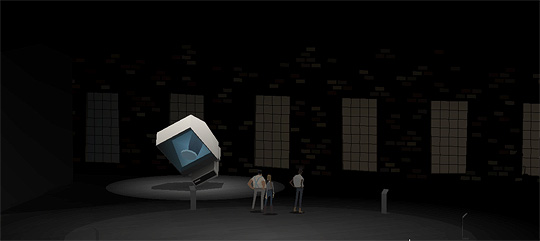
This is a sort-of-review about Limits and Demonstrations, by Jake Elliott and Tamas Kemenczy. It gets just a little spoiler-y, but not in a way that'd seriously compromise your enjoyment.
Most people play chess with pieces and a board, but to many players that's not the actual game -- it's just a mnemonic aid, a thing that keeps track of chesspiece locations so you don't have to remember where your rook is. The people who live and breathe chess, however, can play chess just by reading chess notation in a book, which is to say that the game takes place entirely in their minds. This is more or less what happens when you lose a heated multiplayer match of Starcraft and agonize over what you could've should've didn't do, and wonder what alternate paths you might've taken. Likewise, I'd imagine the most skilled Starcraft players can play Starcraft entirely in their minds.
It's not just in games either: Beethoven was deaf but he could imagine the notes and harmonies so well that it didn't matter, and a Chinese concert pianist was jailed for 6 years but stayed skilled by "practicing in his head."
But I think game designers, designing games directly as a form of conceptual art, is still a relatively new thing.


Thursday, February 7, 2013
A smoother triplanar shader for Unity.
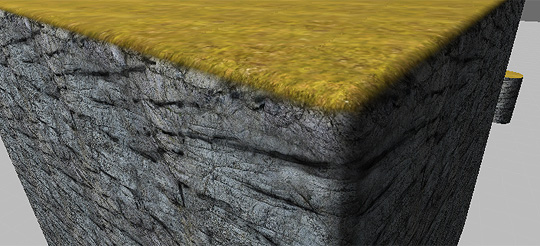
To review: procedural UVs are amazing and you should consider using them in your games. Now, the old triplanar shader I posted was great at hard-edged cubes, but it didn't handle the transitions between textures very gracefully; curved surface like cylinders and spheres were forbidden.
So I took a look at how James "@farfarer" O'Hare handled the blending in his triplanar terrain shader, and how Tom "@quickfingerz" Jackson grabbed normals in his own triplanar shader (but the blending in his shader would "blow-out" a lot, I found) and I combined their respective strengths. I also added different handling for top vs. bottom textures, since grass rarely grows on ceilings. (Textures in the shot above are from Farfarer's pack.) One last change: I let Unity's built-in surface struct calculate world normals instead of calculating my own.
So far, I've been unable to get normal maps working with it, so if any enterprising blog readers would like to instruct me how to do it, and share that technique, then I'd be much obliged.
Here's my shader so far. Do what you will with it:
Sunday, February 3, 2013
Narrative systems workflow; using Fourier analysis and level design metaphors to systemize stories.

I started by arguing that interactive fiction's narrative systems expose too much complexity and detail to its authors and players, or at least more than most people need or want. With Shakespeare, I hope to achieve just a fraction of that functionality, and I think that fraction is enough to be very compelling while facilitating a writer's work.
In engineering Shakespeare, I think of the system in four parts:
a) The real-time system that runs algorithms, interfaces with the game as the player plays.
b) The data / format of narrative itself, how it's structured.
c) The Unity editor interface for generating, editing, or creating the narrative data.
d) The suggested workflow / instructions for using that interface.
Now that I have enough of a base implemented, I'm starting to think more about that last part, the operations design. Roughly, I think the tool could work like this:
Friday, February 1, 2013
My Spring 2013 at Parsons
This semester at Parsons, I have two things going on:
1) I'm teaching an undergrad / grad studio elective course.
Currents: Building Worlds was originally pitched as an "introduction to Unity" class, but then the administration said that Parsons never conducts purely "software" classes. They suggested teaching Unity through some sort of theoretical lens -- and the class design is probably much better for it. So now, it's kind of an intro to Unity / C# / working with expressive 3D / architectural theory class, and it argues for "3D" as a unique expressive medium in itself. There's also a strong focus on discussing "behaviors" theoretically, and how to combine simple behaviors to produce some sort of emergence... whether that's what constitutes a "world." I think I'll assign a chapter of 10 PRINT as a reading? (The "Currents" prefix is like a disclaimer -- "This course is an experiment. Take it at your own risk.")
2) I'm also a "consultant" / aide / "technologist" on another course, taught by Colleen Macklin / John Sharp / Heather Chaplin.
Datatoys is a collaborative class between journalists and design students to re-imagine journalism as a toy -- to turn data into interactive systems that demonstrate patterns of behavior. "Let's face it," began the journalism professor, "reading the New York Times is really boring. Print journalism is dying. Now, what is the journalism of the future?" What are the politics inherent in toys and play? How do we reconcile that with the ethics of journalism? If play is independent and unstructured, does that resemble how journalistic objectivity is independent? Can players act as journalists? How and when do toys lie?
The multidisciplinary nature of these two courses is what makes them conceptually strong and compelling, yet also very difficult to realize into actual designed things... But if they were easy, then they probably wouldn't be worth doing.
1) I'm teaching an undergrad / grad studio elective course.
Currents: Building Worlds was originally pitched as an "introduction to Unity" class, but then the administration said that Parsons never conducts purely "software" classes. They suggested teaching Unity through some sort of theoretical lens -- and the class design is probably much better for it. So now, it's kind of an intro to Unity / C# / working with expressive 3D / architectural theory class, and it argues for "3D" as a unique expressive medium in itself. There's also a strong focus on discussing "behaviors" theoretically, and how to combine simple behaviors to produce some sort of emergence... whether that's what constitutes a "world." I think I'll assign a chapter of 10 PRINT as a reading? (The "Currents" prefix is like a disclaimer -- "This course is an experiment. Take it at your own risk.")
2) I'm also a "consultant" / aide / "technologist" on another course, taught by Colleen Macklin / John Sharp / Heather Chaplin.
Datatoys is a collaborative class between journalists and design students to re-imagine journalism as a toy -- to turn data into interactive systems that demonstrate patterns of behavior. "Let's face it," began the journalism professor, "reading the New York Times is really boring. Print journalism is dying. Now, what is the journalism of the future?" What are the politics inherent in toys and play? How do we reconcile that with the ethics of journalism? If play is independent and unstructured, does that resemble how journalistic objectivity is independent? Can players act as journalists? How and when do toys lie?
The multidisciplinary nature of these two courses is what makes them conceptually strong and compelling, yet also very difficult to realize into actual designed things... But if they were easy, then they probably wouldn't be worth doing.
Saturday, January 26, 2013
More talk, more rock: on algorithmic game narratives, speculative narrative design futures, and "Shakespeare."

Last time, I wrote about procedural narrative in the context of "process intensity." Here, I expand more on designing the procedural / process part.
Back in an expertly-conducted 2011 Rock Paper Shotgun interview, Dan Pinchbeck argued that game development culture unnecessarily separates narrative from the rest of a video game:
"I just want story to be talked about as a gameplay element that sometimes isn’t there. It’s part of the set of tools that a game designer uses to create an experience – and it should be thought of along the same lines, as physics or AI or something more mechanical."
We have physics engines or texture libraries, so why don't we think of narrative as a modular "asset" or "engine" or "library" to be swapped around as well? Why can't narrative be more "mechanical." Where's all the narrative middleware? (Storybricks doesn't seem to be doing too well, unfortunately. I also don't agree with them, that proc narrative is mainly an AI problem...)
Tuesday, January 22, 2013
Devlog: "Conanbowl"

Me and Eddie decided we should make a game this past / current weekend. It started with our usual process: clicking "random page" in Wikipedia until something strikes us. This time, we were struck by "The God in the Bowl," a Conan the Barbarian short story where Conan has to solve a murder (?) when he's actually there because he wants to rob the museum, but then a ghost kills a bunch of people?
Anyway, this concept resonated with us: an adventure-ish game where you must steal things and solve a case; you're a kleptomaniac detective in Victorian-ish London, and you're assigned to cases where you're actually the thief.
Or something like that.
Thursday, January 17, 2013
2/3
At some point, I think I forgot I was making a game. It became more like this expansive simulation of every possible reality, folding into itself; I caught myself wanting to make everything interchangable with everything else, to let every piece talk to another piece and act like yet another. Everything was a network, a graph, and every node was another network. Recursion upon recursion.
There's a tendency in game development to think that you will always be coding "the" framework you can re-use and re-use for everything. Everything should be modular, endlessly recyclable, endlessly useful. It's hard to let that go and accept that you should focus on making a game, first -- a game that works -- and not an engine or a library or something that'll change everything as we know it. I ended up forgetting the most basic lessons of making.
Convo felt too big, and it felt too big by 2/3. I had to cut 2/3. I don't know how I can quantify a fraction like that, but I thought about my ability to build and engineer and develop, within the timeframe I wanted, and decided it was overextended by at least 2/3. I've cut a bunch of stuff, but I'm not sure if the scraps on the floor -- do they add up? Is it enough? How do you know if you've cut too much? Is this what Peter Molyneux feels like?
More details soon...
There's a tendency in game development to think that you will always be coding "the" framework you can re-use and re-use for everything. Everything should be modular, endlessly recyclable, endlessly useful. It's hard to let that go and accept that you should focus on making a game, first -- a game that works -- and not an engine or a library or something that'll change everything as we know it. I ended up forgetting the most basic lessons of making.
Convo felt too big, and it felt too big by 2/3. I had to cut 2/3. I don't know how I can quantify a fraction like that, but I thought about my ability to build and engineer and develop, within the timeframe I wanted, and decided it was overextended by at least 2/3. I've cut a bunch of stuff, but I'm not sure if the scraps on the floor -- do they add up? Is it enough? How do you know if you've cut too much? Is this what Peter Molyneux feels like?
More details soon...
Saturday, January 12, 2013
The unportalable: games as paratexts and products

Several years ago, I sat-in on a "games as literature" course, and promptly got into an argument with the instructor. We were talking about Portal, and he argued the dark metal unportalable surfaces seem "sinister" because of their color, rustiness, sense of alien materiality and permanence, lack of affordance, etc. (This was also an introductory course, so a lot of his effort went towards getting students to make critical arguments about games at all.)
I argued that interpretation was irrelevant, and that type of thinking was obfuscating how these surfaces actually function to players: in Portal you don't think to yourself, "that wall is scary," but you more often think "I can't portal there, let's look somewhere else" or "wow that wall looks cool on these graphics settings." To me, the wall material told more of a paratextual story rather than a diegetic story.
Tuesday, January 8, 2013
Kentucky Route Zero (Act 1), by Jake Elliott and Tamas Kemenczy

The first act of Kentucky Route Zero is now available for purchase, conveniently on the same day as the news that it has more or less swept this year's IGF nominations. The praise is well-deserved. Cynically, you could sum it all up as Sword and Sworcery + Prairie Home Companion + the love child of a Jorge Luis Borges / David Lynch / Flannery O'Connor threesome (except, uh, less violent). It is a game consisting almost entirely of moods.
Tuesday, January 1, 2013
Convo's current epistemology spec / knowledge model

In Convo, characters do not have fixed names or skill stats, exactly. Instead, they have knowledge that they selectively believe about themselves and represent to others.
One character might have knowledge that they are sometimes Josef, a French civilian with 8 mind points. Someone else could also have knowledge that they are sometimes Josef, an Abwehr officer masquerading as a French civilian with 6 mind points and lockpicking abilities. Both characters can claim to be "the" Josef, and perhaps both characters are the Josef. The "truth" is partly whatever you can get the people who matter to believe -- that might be a commander, a guard, or a farmer, or whomever you need to accomplish your goals at a certain time and place. A "person" is just the sum of their knowledge and what other people believe and perceive about them.
This knowledge model, of separating objects from their qualities, describes personal identities -- but it also describes the entire world and what happened in it. To some extent, the world doesn't exist, just traces of it.
Thursday, December 27, 2012
The 2013 Queer Feminist Agenda for Games
Identity politics in video games are on the rise: there are more transgender, gay, or queer people in games speaking out about their experiences, and more women are speaking up about harassment and discomfort that pervades game culture. As we approach next year and consolidate / organize / build-up this wonderful "queer feminist game culture" coalition, here are the major issues currently on my mind:
Tuesday, December 25, 2012
Amnesia Fortnight design notes / analysis: "Autonomous"

I played the Double Fine Amnesia Fortnight prototypes without watching their pitches or videos or reading anything at all about them, so my descriptions / genre framing might be different from the "official" language used. MECHANICS SPOILERS BELOW...
Autonomous is a first person game where you build and "program" robot NPCs to battle hostile NPCs / mine resources for you.
Saturday, December 22, 2012
Just around the corner, always out of reach...
UPDATE, 19 June 2014: I have given up on this project, and I'm open-sourcing the project files.
The ballad of the bloodthirsty poet. Still a lot left to do...


Current to-do list:
- redo door textures
- redo hologram textures
- fix the buttons so the level is completable again
- add gubbins and doodads, geo detail pass
- tweak lighting (esp. plants in gravity chamber, boost crystal .rad)
- redo skybox, add space jellyfish (?)
- carve channels into the main chamber floor
- data effect pass: entire complex comes to life
- garg?
The ballad of the bloodthirsty poet. Still a lot left to do...
Current to-do list:
- redo door textures
- redo hologram textures
- fix the buttons so the level is completable again
- add gubbins and doodads, geo detail pass
- tweak lighting (esp. plants in gravity chamber, boost crystal .rad)
- redo skybox, add space jellyfish (?)
- carve channels into the main chamber floor
- data effect pass: entire complex comes to life
- garg?
Friday, December 21, 2012
Deceptive epistemologies in strategy game interfaces, and a theory of strong vs. weak fallibility.

When you play Command and Conquer or Starcraft, you're supposedly some anonymous commander at a console who can see everything and command everyone via some combination of technology and/or space magic. When you play Warcraft, maybe you're looking into a magic mirror. When you play Company of Heroes, uh, you're... uh... a plane is flying above and radioing battlefield recon back to HQ, and some lovely women in neat khaki caps slide pieces around on a map?...
As far as user interface framing goes, there's very little metaphor outside of fantasy magic and holographic virtual magic. Of course, none of these are "problems" in these games, because everyone knows it's a trick -- that is, we all know it's just some stupid bullshit that doesn't matter, and that's okay. ("Tetris doesn't need a plot!!!")
But the only way to coherently read this kind of fiction is to disembody it, to assume you're more like some abstract "force" -- maybe you're the collective human will to survive or collective unconscious manifestation of nationalism, some system of belief guiding all these people and resources toward some grand purpose that few of them can imagine. (Frozen Synapse imagines that you are literally "Tactics," the player character is the squad's abstract ability to think, perceive, and act.)
Thursday, December 20, 2012
A confirmed heart
A month ago I wrote about the Heart in Dishonored, and I'm glad my suspicions (it's a dressed-up radar / hint system / audio guide) were correct in this semi-interview at RPS with Arkane devs.
I can't say I share the author's admiration of its narrative results as meaningful narrative -- I found it way too transparent and instrumental in what "they wanted you to feel", which is why the Outsider NPC fails for me -- the designers want to narrate and interpret everything for me, to explain their game. I don't think it's subtle. (Comparatively, the Outsider's dad, the G-man, usually ends up confusing me more than anything. His magic is genuinely mysterious and Gordon Freeman never gets any access to it. In contrast, the Outsider isn't mysterious -- he's just an unexplained writer mouthpiece / deus ex machina / character with no stake at all in what goes on, it's hard to care about a non-presence)
So now I think the way forward for the industry (I believe in a "way forward" because I think novelty is extremely important in art, not in some game industry myth of innovation) to develop its storytelling techniques is, ironically, to listen to that crazy Far Cry 3 writer and think of an entire game as narrative, rather than confining narrative to an isolated series of dioramas with doomed corpses and "poignant" voice over narration. Some of the best indie games do this already: your entire experience is the game narrative, not just some one-off readables or loading screen lore that a writer typed into a spreadsheet.
How do you explain insanity
I remember talking to a game journalist about the difference between interviewing AAA developers and indies. He said a lot of indies and academics never stop talking, but AAA developers get quieter much faster -- maybe they were trained by PR or maybe they're tired? who knows -- but the most recent exception was an interview with a Far Cry 3 dev. This was back in August, so I was thinking, "oh yeah Far Cry 3, they're making that huh," and listened.
He said the Far Cry 3 interview was interesting because apparently the writers did a lot of research on insanity. They wanted to deconstruct insanity. They even featured an insane NPC as the character in the cover art, not the player character / protagonist, which was probably the first sign of them overestimating the importance (or, player interest) in all these details.
"But how do you explain insanity in rational terms?" I asked, "and I saw the trailer, it just looks like -"
The journalist nodded, "yeah, I know."
(Unrelated to insanity: this strange interview with the Far Cry 3 writer.)
He said the Far Cry 3 interview was interesting because apparently the writers did a lot of research on insanity. They wanted to deconstruct insanity. They even featured an insane NPC as the character in the cover art, not the player character / protagonist, which was probably the first sign of them overestimating the importance (or, player interest) in all these details.
"But how do you explain insanity in rational terms?" I asked, "and I saw the trailer, it just looks like -"
The journalist nodded, "yeah, I know."
(Unrelated to insanity: this strange interview with the Far Cry 3 writer.)
Tuesday, December 18, 2012
new game: "Barback" for Ludum Dare #25

Theme-wise, perhaps it doesn't really fit with the "You are the villain" theme, now that I'm done with it and looking back. I didn't want to make a game with obvious villains, but I think about my mental concept of a "villain" and by definition it seems to involve blatant villainy and a twirlable moustache. In this narrative, the villains are mundane: your own crushing feeling of failure, or people who care about you but are very pushy, etc.
Sunday, December 16, 2012
some more words on the AAA manshooter / text games
I have a knack for sending too much material to journalists when really they just want a quote or two. I promise to stop doing that. In the meantime, John Brindle's posted up the rest of my response from a piece he did about text / introspection / war games. It's cross-posted here, with some marked edits.
Saturday, December 15, 2012
Triple Jam Pile-up this weekend!
This weekend is the classic monolith of game jams, Ludum Dare #25! Theme is still pending for a few more hours...
Also, this weekend in New York City is a special game jam hosted at Parsons called "Game On", co-sponsored by Github and Mozilla. The main requirement is to make an HTML5 game. Prizes include a trip to GDC 2013 (wow!) and I think there's free food to jam with, at least. (And as long as you're here this weekend, also check out Spacewar! at the Museum of the Moving Image, charting the long lineage of shooters from ur-game "Spacewar!" on a PDP-1 replica through Metroid II and ending with Halo 4.)
ALSO, this month in Chicago, there's the Six Pack Jam. Jake Elliott and friends are putting an arcade cabinet in some bar in Wicker Park and they want cool games to put on the cabinet! Here, the implied constraints are 2 player compatible modes with short arcade-scope play sessions, but maybe that's just my interpretation.
You could, potentially, make a 2 player HTML5 game with [LD theme] and submit everywhere. Whoaa.
Also, this weekend in New York City is a special game jam hosted at Parsons called "Game On", co-sponsored by Github and Mozilla. The main requirement is to make an HTML5 game. Prizes include a trip to GDC 2013 (wow!) and I think there's free food to jam with, at least. (And as long as you're here this weekend, also check out Spacewar! at the Museum of the Moving Image, charting the long lineage of shooters from ur-game "Spacewar!" on a PDP-1 replica through Metroid II and ending with Halo 4.)
ALSO, this month in Chicago, there's the Six Pack Jam. Jake Elliott and friends are putting an arcade cabinet in some bar in Wicker Park and they want cool games to put on the cabinet! Here, the implied constraints are 2 player compatible modes with short arcade-scope play sessions, but maybe that's just my interpretation.
You could, potentially, make a 2 player HTML5 game with [LD theme] and submit everywhere. Whoaa.
Tuesday, December 11, 2012
Tiny Soccer Manager Stories, by Pierre Corbinais

My very strong favorite of the TIGSource "Sports" compo is Pierre Corbinais' "Tiny Soccer Manager Stories." It's a 20 minute-ish puzzle game made in Adventure Game Studio that tasks you as a substitute junior high soccer coach, and your job is to balance the two teams to make sure everyone plays, even the kids who suck.
(INSTALLATION NOTE: To get this to run on my Win7x64 system, I had to change the settings to "Direct3D 9" windowed mode. Try that if it doesn't work for you.)
(HINT: If a particular puzzle gives you a lot of trouble, use the "Skip Puzzle" option in the menu. The game doesn't penalize you or limit you at all.)
I've whined before about how we should narrativize the sports genre, and I think TSMS does some really great things with game narrative using this roster mechanic -- it isn't the first sports mechanic that comes to mind, which just makes this all the more refreshing and novel. Here's why this game is awesome: (SPOILER ALERT)
Monday, December 10, 2012
CFP: "Different Games" at NYU Poly, due Feb 1
Different Games is a new game conference in NYC that focuses on race / gender / sexuality / disability / politics in games. If you have something to say or make (game / installation / workshop / talk) then you might want to submit something by Feb 1st. More info at http://www.differentgames.org/cfp/
(Also, NYC is at its best in April...)
Saturday, December 8, 2012
Recent happenings at New Statesman
Liz Ryerson recently linked here in her "recommended game criticism reading list" at the New Statesman, and John Brindle recently wrote a piece for them about text-based games commenting on war better than AAA counterparts with a few quotes from me on the topic. Check it out.
Thursday, December 6, 2012
Specially Level with Me, at Rock Paper Shotgun (updated)

Part 2 is up now. We talk about Portal 2 puzzle design, inspirations behind the underground chapters, and certainly nothing about HL3.
I talk more in this part than the other part because I'm trying to figure out why Adam Foster's work is so good -- is it because his floorplans are so 3D and holistic? Is it his bold use of symmetry in places? Someplace Else has a structure you don't see in-game: the alien complex has a spine, ribcage, and even some kind of pelvis with vestigial legs. I thought Half-Life 1's r_speeds were keeping him from linking all the areas and making this structure more apparent, but after the interview, I think it's more that he likes keeping some secrets to himself.
And to "justAModsLover": I totally forgot about the Someplace Else port, and I'm going to make that my winter project.

Part 1 of my interview with Adam Foster, fancy modding celebrity genius / Portal 2 level designer / one of Valve's ARG masterminds, is now up. (And, okay, I ask him about HL3 in part 2...)
I hope people notice my image curation cleverness re: putting a screenshot of his older HL1 mod Parallax with a giant funicular cargo lift next to a more recent screenshot from Nightwatch with a giant funicular cargo lift. Gotta love the hazard stripe trims. In both levels, these were pretty big epic setpieces and more or less define how the rest of the level is structured. The best part is that they all contradict the original funicular setpiece from HL1, the slow headcraby-descent in the middle of Unforeseen Consequences -- there are no monsters suddenly spawning in either of Foster's versions (if I remember correctly in Parallax?) so you just enjoy the ride and scenery, though you're probably on edge the entire time.
If you're an Adam Foster fan, I do encourage you to check-out Parallax. It's so old and a bit buggy, but the structure still feels pretty modern.
Wednesday, December 5, 2012
Teaching game development community.
In Spring 2013, I'll be teaching an undergrad / grad Unity course at Parsons called "Currents: Building Worlds."
The course has a few learning goals -- (a) to gain a broad conceptual understanding of how Unity works across art assets and code, (b) to learn some useful software engineering patterns for games, (c) to develop self-sufficiency for solving Unity problems / "learn how to learn", and lastly (d) to recognize membership in a global game development community.
That last one's probably the most ambitious.
The course has a few learning goals -- (a) to gain a broad conceptual understanding of how Unity works across art assets and code, (b) to learn some useful software engineering patterns for games, (c) to develop self-sufficiency for solving Unity problems / "learn how to learn", and lastly (d) to recognize membership in a global game development community.
That last one's probably the most ambitious.
Saturday, December 1, 2012
Using screen-buffer masks in Unity Pro for a fog of war effect.

Also, you don't have to use this for fog of war. You can use it anytime you need to mask-off certain bits of the camera view on a per-object, per-triangle, or per-pixel basis. Like, maybe you'd want some stuff to glow red?...
The gist: (you will need Unity Pro since this uses render textures)
1) A camera's render texture is in RGBA format. You can technically do whatever you want with the alpha channel; most of Unity's built-in shaders use it to mask out alpha textures for various image effects.
2) If we use a shader that writes only to that alpha, we can use it to mask objects or pixels.
3) Then, we edit the image effect shader to modulate an effect with the alpha channel values.
If you need some more details and shader code, read on...
Tuesday, November 27, 2012
Radiator Blog: Three Year Anniversary

Wow, I've been blogging here for about 3 years now. This blog is now approaching the end of its toddler years. Much like last year, and the year before, here's a "greatest hits" compilation of this past year's posts:
(Oh, and feel free to have some cake. Forks and plates are over there, on the table.)
GAME ARCHITECTURE CRITICISM
- Why game architecture matters and the reality / unreality of de_dust. If digital life is real-life, then digital places are real places. QED.
- The shape of crime and escape. Notes from a BLDGBLOG panel / talk on heists and bank design, and me trying to apply it to game architecture. Sort of a sequel to last year's "On the first person military manshooter and the shape of modern warfare" which takes off from another BLDGBLOG talk on military infrastructure as war.
- Infinite Omaha. I went to the real-world Omaha Beach, then compared it to various video game portrayals of Omaha.
- The shadow of the white cloud: architecture criticism at the 1893 World’s Fair and BioShock Infinite. These days, I'm more reluctant to credit the upcoming BioShock Infinite with intellectual subtlety -- it's a game where you shoot men while riding ziplines -- but still, "City Beautiful" is one of the most influential and distinctly traceable trends in architecture ever. It's also a forerunner to thought on Disneyland, theme parks, and "artificial" architecture.
- A short history of non-monoplanar first person movement. The biggest con of non-monoplanar movement is that it's hard to make giant impressive sweeping landscape levels: you're usually either stuck inside a padded room, or you're running outside on an asteroid, and neither offers a grand vista because you're either inside or outside but rarely just off to the side. The horizon is always shifting.
- What makes good writing on level design? I think writing is best when it's specific, and here I try to articulate what I like about certain writers' styles.
- On Joiner and the cult of greeble. If Sleep No More spams readables to show how much money went into it, then TF2 maps spam meticulous func_detail brushwork to imply the mastery and skill of the level designer. What happens when you automate the writing of readables, or automate the placement of detail? I think indie developers are more conscious of the cult of detail than AAA devs, mostly because detail is expensive to add.
COMMISSIONS
- Level With Me, a post-mortem. A Portal 2 mod I did for Rock Paper Shotgun. The level design is some of my better work, and I like the idea of game journalism in the form of games, but it seemed somewhat cooly received. I have to conclude that it must simply be not as good as I think it is... or that Portal 2 players are super lame.
- The Future of the FPS, written for PC Gamer UK in issue 240. A short essay and list of really cool indie FPS games and how they're changing the genre, kind of the basis for my later RPS series. Thanks Graham!
- A People's History of the FPS. A three-part essay series for Rock Paper Shotgun that argues mods are transcending their video game bodies, becoming genuine culture that is increasingly independent of the products that they're meant to be "modding" and adding value to.
ON GAME NARRATIVE
- The myth of psychological realism in narrative. Argues that thinking of fictional characters as "people" is meaningless for a writer. It is much more useful to write by thinking of a character as a vehicle for plot, and let the player fill-in character for themselves.
- Dishonored fails as an immersive sim in its first minute. The simulation should be "immersive" -- meaning, the scope of it should be consistent and everywhere. Scripting special cases goes against this genre dogma.
- Dishonored uses the Heart to lie to you. You'd expect the Heart to be an unreliable narrator of some sort, but it doesn't lie to you with narrative -- it lies to you through gameplay and psychological framing.
- "Stair K": architecture criticism, Thief, and a coffee maker. Situates Thief as dialog on social class and urban architecture. (e.g. stairs are invisible to rich people who take taxis, not subways, and frequent buildings with abundances of elevators) It argues that in Thief, stealing is framed as an ethical act because the rich deny the truth and infrastructure of cities.
- Thief 1's "Assassins" and its environmental storytelling. I really hate the type of analysis that just thinks of game narrative as a static text that you read -- game narrative is also a game design tool, a way to make the game better to play. Games tell stories, yes, but those stories tell games too.
- What do simulations simulate? Argues that a simulation gap is important for framing a narrative.
- The structure of Sleep No More (part 1, no spoilers) and (part 2, detailed and spoilery). You paid a lot to see this damn show everyone's raving about and now you're inside, on a timer. Are you going to spend your valuable time (a) reading faint scribbles on random pieces of paper under a dim flickering light-bulb or (b) follow the crazy naked people who have an interpretive dance orgy in a blood-smeared disco?
I still think a lot of "game critics on Sleep No More" like the idea of it more than how people actually consume it -- unfortunately, reading is boring and performance is captivating. So I argue the readables function as set dressing to assure you of the production's expense, not to serve as barely coherent narrative in a familiar plot that's hundreds of years old. Of course, the dancing's fantastic, but I guess it's hard to argue for the value of dance to gamer culture. - Rule Databases for Contextual Narrative. On modding Valve's dynamic self-branching conversation system and using it to author dynamic self-branching narrative, and how Emily Short's already doing something like that, naturally. I think it's one of the more promising directions toward a holy grail of procedural narrative.
- Balls and conversation: let's narrativize the sports genre. I really love baseball movies, but I'm really bored by the focus on statistics, which is probably why Moneyball sucked. There's a rich tradition of sports narratives in film and literature, but in video games it's conspicuously absent. Let's change that.
- "Do you think shooters take themselves too seriously?" We watch blockbusters in a special way, I think, but the gulf between action films and action games is this: the films are structured to be human and sympathetic, but games are sociopathic and mean. This is a game narrative writing problem.
ON GAME CULTURE
- Frog Fractions should really win something at the IGF.
- On appreciating the UV texture flat as fine art. Here, I propose three aesthetic modes for enjoying texture flats on their own merits and glorifying them as authentic game art, rather than the silly concept art we parade as game art. I later re-wrote this piece for Game Developer magazine, as "Loving the Bones."
- Desperate Gods and rules-forcing in games. Pretty recent, but I think it's a good summary of current thought on the issue -- if you can play a game of Starcraft in your head, and Starcraft exists fundamentally more as a mental construct than a product, then why can't we just argue the rules of Starcraft in the same way we interpret and amend the laws of board games.
- On grad school for games / what studying at Parsons was like. Imagine a cohort of game developers from all around the world, and 50% are women, and 10% aren't straight people. Parsons is like the rainforest: diverse, beautiful, and vital to the global ecosystem -- but it's also humid, with lots of insects everywhere, and it's constantly in danger of deforestation. It's not for some people, while others will really grow to love it.
GAME CONFERENCE / FESTIVAL NOTES
- Why Indiecade is the best games conference / festival I've ever been to. It might sound like hyperbole but it really isn't.
- I spoke at Games for Change this past year, on LGBTQ attitudes and developers in games. It went great. I began with "I'm Robert Yang, and I'm a practicing homosexual" -- and the entire auditorium erupted in applause and cheering. It was an amazing feeling.
- Notes on the Games for Change industry. Fun fact: I got into an argument with a G4C speaker in the comments. His stance -- yeah the games suck, but people want to put a lot of money into this, so just accept it. My stance -- art should be a free or reasonably available public good, not a product.
- How the worst part of the game industry uses PAX East to teabag your entire face with its cancerous scrotum. I encourage everyone to go to at least one big mass market game convention, because that's when you will know what "indie" really means and you'll realize how small, puny, and insignificant we "video game intelligentsia" really are. The sheer amount of money being thrown around in this industry is insane -- the money spent on a 20-foot tall Blops booth-complex, blaring out noise at a regular interval, is a huge contrast to the humility and humanity of indie game culture.
- What were the main trends of GDC 2012? A look-back on what happened and what stuck out as significant.
UNITY TUTORIALS / RESOURCES
- Shader-based worldspace UVs ("triplanar") in Unity. The worst thing about BioShock's environments is the cookie-cutter feel of the game architecture, the result of modular building in game engines today. The scale and proportions don't feel human or plausible. To me, one answer is to embrace old school BSP construction techniques with procedural UVs so that you can scale your primitives to arbitrary sizes without texture stretching.
- How to integrate Unity and Twine. Notes on Unity's web player JS hooks, and how that can feed into Twine's JS, or any webpage's JS, really.
- How to dig holes in Unity terrains. How to use depth mask meshes to selectively mask geometry, then disable the terrain collider temporarily.
- The best Unity tutorial writer in the world. He really is. I'd pay him to write a book, in fact, but unfortunately I'm poor.
Friday, November 23, 2012
Desperate Gods and rules-forcing in video games.
Desperate Gods, by Wolfire Games, is a virtual board game made for Fuck This Jam; you have a bunch of virtually simulated tokens and cards, but you must process and execute the game rules yourself. You can easily cheat, but then what's the point?
DG is not the first game or toolset to do this, although it's certainly the most polished and nicest looking so far. LackeyCCG, for instance, gives you a deck builder, a table, some tools for keeping track of state, then walks away and lets you get to it. The rationale, from their FAQ:
Q: Does LackeyCCG force people to follow a CCG's rules? Will it allow me to do something that isn't legal?
A: LackeyCCG does not implement rules forcing. I have tried other methods of playing CCGs online and I have found that forcing rules adherence just serves to bog down the game and makes it much less fun to play. Lackey allows you to simplify your turn when not much interesting is happen (so you can get to the more fun parts of a game faster). LackeyCCG will allow you to do anything you could do if you were playing with real cards. It also allows for a more formal adherence to the rules if you want to play that way, but it doesn't force any particular play style.
Saturday, November 17, 2012
On why Convo is now a WW2 spy romance, and the myth of psychological realism in fiction.

Short version: I've chickened out, a bit. Long version?
To make some sort of procedural "anything", you have to have an idea of what the building blocks of that "anything" are, or at least what you'll argue they are -- and then either frame your game in those terms or expressly simulate those terms. So if Convo is a game about narrative instead of people, then what's a unit of narrative?
From there, my thinking goes like this...
Saturday, November 10, 2012
Dear Esther postpartum, by Robert Briscoe.
Rob Briscoe has put-out a really heart-felt, personal, death-defying postpartum on Dear Esther.
I think if you ask the vast majority of career game developers out there (or anyone, really) what they're worried about -- it's probably money.
It's industry developers without any job security or a job, where shipping a title means the publisher will force layoffs to improve their quarterly financials. It's the average indies who glare at their monthly 3 figure check from their meager sales, assuming it's even that much, and wonder what that'll buy after rent.
Briscoe had to sacrifice a lot and felt poised to fail throughout the entire process, even though everyone was telling him that Dear Esther was going to do well. Given popular depictions of game development, it seems success comes to those who risk everything to the point of emotional breakdown.
Can we, in good conscience, recommend careers in game development (AAA or indie) to the uninitiated when our passions often lead to the verge of self-destruction? I guess you never hear about the developers with stable lives, happy families, and financial security -- their lives aren't stories -- but isn't it scary to think that passion can easily lead to hell instead of the good life?
I think if you ask the vast majority of career game developers out there (or anyone, really) what they're worried about -- it's probably money.
It's industry developers without any job security or a job, where shipping a title means the publisher will force layoffs to improve their quarterly financials. It's the average indies who glare at their monthly 3 figure check from their meager sales, assuming it's even that much, and wonder what that'll buy after rent.
Briscoe had to sacrifice a lot and felt poised to fail throughout the entire process, even though everyone was telling him that Dear Esther was going to do well. Given popular depictions of game development, it seems success comes to those who risk everything to the point of emotional breakdown.
Can we, in good conscience, recommend careers in game development (AAA or indie) to the uninitiated when our passions often lead to the verge of self-destruction? I guess you never hear about the developers with stable lives, happy families, and financial security -- their lives aren't stories -- but isn't it scary to think that passion can easily lead to hell instead of the good life?
Friday, November 9, 2012
Dishonored's narrative design: how The Heart lies to you.

(UPDATE: this interview at RPS with Arkane devs confirms that not only was I right, but that it was also a very conscious decision on their part to make it do that, wow.)
Dishonored does a lot of things with game narrative (abstract dream levels, scripted body awareness, lots of readables, overheard conversations, scripted sequences, branching missions changing based on player decisions) which fit neatly into the existing immersive sim / first person toolbox that we're used to. It's well-done, but it's not particularly new or anything.
The Heart is something slightly different, though, and I found it surprisingly subtle and ironic.
Level design / character SPOILERS (but no plot SPOILERS) below:
Thursday, November 1, 2012
Convo and "what do simulations simulate?"

In games, I argue that players never forget they're playing a game or simulation, but they're willing to suspend their disbelief and ignore the gap to enjoy themselves more. I think the term "immersion" in the sense of "forgetting you're playing a game", then, mischaracterizes this dynamic and implies the simulation is all-encompassing and consumes the player, when really, it's important that games are NOT holodecks and it's a good thing that they aren't.
As designers, one of our jobs is to "sell the simulation gap" and make it an asset instead of a liability.
Thursday, October 25, 2012

"Zobeide" at Playing The Game, 27-28 October in Milan

I'm fixing up Zobeide / adding a few features for yet another Lunarcade event, this time at "Playing The Game" in Milan from 27-28 October at Spazio O' Artoteca. If you're around, then you should attend, if for no other reason than to play XRA's mesmerizing "Memory of a Broken Dimension."
Machine translated website copy (from Italian to English) is after the jump:
Thursday, October 18, 2012
Talking about Convo.

My favorite version so far has been, "it's an attempt to make The Sims accessible for hardcore gamers."
The argument is that social simulations like The Sims and Prom Week are actually really complicated systems, more complicated than most supposedly "hardcore" games -- like, I tried playing Prom Week again the other day, and couldn't understand how to achieve anything because each character has a dozen abilities and a dozen moods and a dozen relationships. It seemed like a brute force approach to simulation, to dissect the gamut of human feeling and then to directly design and represent each facet. Don't even get me started on how much stuff is in The Sims... it's all very fascinating, but it's also really intimidating.
But take something like XCOM -- I really like how there are just 3 core verbs (move, shoot, overwatch) that produce a variety of situations. However, the player stories consist mostly of "my squad was in danger and we survived" or "we got massacred" or stuff along those lines. I don't think XCOM's relatively limited range of emergent narratives come from its limited verb set; I think they come from the premise of its simulation, a military squad battling aliens. What if we replaced that premise with, uh, the mundane but thrilling dramas of everyday life?
"My bros were in danger but one chatted up a really hot girl, but then she started talking about particle physics which he knew nothing about, so I had him text his friend about particle physics so he could talk to her instead. Turns out, they both hated plaid."
Other elevator pitches:
- "It's like XCOM plus Jersey Shore."
- "It's about applied linguistics and binge drinking."
- "It's like XCOM plus Love Actually."
Tuesday, October 16, 2012
Dishonored fails as an immersive sim within its first minute.

I'm being dramatic here; Dishonored is pretty well-designed and gorgeous and I enjoyed myself. I liked Dishonored, on the whole. However, I couldn't help but notice that Dishonored, taken as the immersive sim it keeps insisting it is, fails within its first minute under that tradition. It fails upon giving you your first choice:
Do you want to play the tutorial or not?
Tuesday, October 9, 2012
Indiecade 2012, notes

Part of me thinks I shouldn't even write about Indiecade: it's something that should be jealously protected from all the evil in the world. Its "independence" doesn't refer to the substantial indie attendance; it refers to how differently it does things, standing apart from the giant game conventions I've been to:
- It's for the public. The "village" consumes the better half of the Culver Hotel parking lot / plaza, and you have a constant stream of random people strolling in. The finalist arcade is inside a firehouse. Various panels and talks are in random auditoriums / civic institutions. This is a festival that's actually interfacing with a city and takes pride in what a city is, while other conventions are so huge they isolate themselves in compounds far from city centers.
- Real access to people. Want to talk to Jonathan Blow? Well, he's sitting on that bench over there. All those darlings you follow on Twitter? Over there, getting a beer. Los Angeles' lack of effective public transit means that people generally stay around the festival area and it's easier to find / meet people, ironically.
- Really good cookies. Damn, those were good cookies.
- Real engagement. There was a talk about queer games and people asked critically interesting questions: What, structurally, is a queer game? Is identity politics a distraction from more pressing issues like the indie-industry relationship? Across the entire festival, there were very few stupid questions, very little noise about "that's not a game" or "this genre is better than that genre" -- work was approached on its own merits.
- It's not really about business. I mean, business totally took place -- Sony is a major sponsor and is definitely the most indie-friendly publisher I've seen -- so it's there if you look for it, but otherwise you'll never drown in it, which is really nice.
Saturday, October 6, 2012
MINERVA Month!
As queen of all mod-dom, I do declare October to be MINERVA Month -- this year, celebrating the 5th anniversary of Adam Foster's MINERVA: Metastasis! Loyal acolytes are hereby advised to investigate new documents leaked to the public: https://hylobatidae.org/minerva/blogsheep.php?action=articleinfo&id=115
Also, look out for some MINERVA-related things, due out for later this month, if the stars align...
Also, look out for some MINERVA-related things, due out for later this month, if the stars align...
Wednesday, October 3, 2012
"Loving the Bones" in Game Developer magazine, October 2012

Wednesday, September 26, 2012
A bit about Convo.

I remember when I was of legal age (okay, well, of kinda somewhat legal age) and I started going to bars. Who teaches you how to behave at a bar? How do you know how much to tip a bartender if at all ("$1 a drink, usually, in the US") or what tabs are ("you pay when you leave") -- is it weird if you're there by yourself? (Sometimes.) When do you buy a round for everyone? (Sometimes.) When is it okay to check your phone? (It depends.) There are all these rules of socialization that we internalize without thinking, practicing them until they become reflex. Different bars in different places have different rules, and we wordlessly sensitize ourselves to each arena.
But even before we enter bar culture, we get socialized at a much more basic level -- in the art of conversation. How do you know when it's your turn to talk? When can you make a joke? When can I leave a conversation?
My prototyping process has involved a lot of linguistics research along these lines, mainly focusing on an old (now somewhat irrelevant?) branch of applied linguistics called "conversation analysis." It might be really hard to teach an AI just how to time its responses and get into the rhythm of things, but there are 5 year olds who effortlessly achieve gapless conversation on a daily basis. I find that fascinating -- and where there's elegance and an element of timing, there's strategy and a game.
To be clear, my goal isn't to solve "procedural conversation generation" in any way, but rather to sidestep it. Convo is NOT about "what" you say or "how" you say it -- it's mostly about "when" you say it.
I'll post more about Convo as I develop it.
Thursday, September 20, 2012
A People's History of the FPS, on Rock Paper Shotgun

I've turned my No Show Conference talk into a 3-part essay series for Rock Paper Shotgun. It argues for a long-standing but suppressed tradition of non-industry involvement in the first-person genre, and that the nascent "renaissance of the FPS" isn't really that recent. Instead, we mentally blocked out the "innovation", then complained why there wasn't any innovation.
Part 1 talks about the Doom WAD scene and the murder of Myst.
Part 2 argues that FPS mods were a way to break into the game industry, so we had to think like the industry too, even if it was dysfunctional / self-destructive for us to do so.
Part 3 observes that many people mod today without any regard for an industry job, and the career path for post-amateur modders is now unclear because of the indie scene. It also argues that many mods are now "postmods" in that they don't care if they ever get played, among other reasons.
Wednesday, September 19, 2012
How to Make Games with Twine
Public service announcement: Anna Anthropy has written a great short tutorial on making games using Twine -- it's perfect for people with little or no game development experience at all, and will allow you to make cool text-based games with choices and stuff.
Saturday, September 15, 2012
"Do you think shooters take themselves too seriously?"

If you're actually serious about war, then military shooters get 99% of it wrong. The US fights wars with unmanned drones, viruses, trade embargoes, and giant bases they airlift to the middle of Afghanistan. More significantly,
So, instead, I think modern military shooters are best understood as Hollywood blockbuster action movies. If we think about it like that, Die Hard takes the geography and materiality of the setting (the mechanics of action) VERY seriously -- in the beginning, Bruce Willis' character takes his shoes off to relax his feet on carpet because he's a stressed-out NYPD cop, but then later he has to walk on broken glass with his bare feet, which has consequences. The movie spends a lot of time on this, and makes sure the line of causality and punchline for the bare feet are all consistent and feel earned... but it spends all of 2 minutes dwelling on the thematic backdrop of terrorism and Japanese-American corporate culture. Bruce Willis is charismatic and human enough for Die Hard to work like this.
Wednesday, September 12, 2012
Excavating Adam Foster

I'm approaching my Someplace Else port to Source very differently from how I approached my early work on the Anomalous Materials chapter of Black Mesa Source. There, I felt I had significant license to add rooms and change architecture styles.
Because Someplace Else is so combat-heavy, it feels strange to do that. Anything beyond higher resolution textures, new shaders, and more surface geometry requires justification, which means studying what Foster did and extrapolating what he would've done with more resources and higher memory limits.
In the history of level design archaeology, I think the most convincing piece of writing has been Channie on the laundry room in Favela from Modern Warfare 2.
I don't think I'll be able to achieve such certainty about something, but it'll be fun to think about.
Friday, September 7, 2012
Greenlight, briefly.
$100 is not a huge amount of money to me. It's okay if it's not a lot of money to you either. Being rich and having privilege is not a crime -- however, being oblivious and insensitive is a crime, or at least unethical. You should own your privilege: understand what that means and understand that others have much less or much more.
As game designers, you should already know that it doesn't matter what a rule was intended to do. It matters what a rule actually does.
And when a lot of indies are brave enough to admit they're poor, and say that this rule discourages them from submitting to Steam for their best / only chance at some semblance of financial security based on their very good and deserving work (look at any indie's released sales numbers and the pie chart looks like Pac-Man with a nearly closed mouth; that is Steam's market share) -- when they say they are in pain, I am not going to tell them their pain is their own fault, or that their pain is imaginary, or that they're better off with their pain anyway.
Poor people deserve to make and profit from games too.
So please don't shut people out, because that's just one more door we'll have to kick down.
As game designers, you should already know that it doesn't matter what a rule was intended to do. It matters what a rule actually does.
And when a lot of indies are brave enough to admit they're poor, and say that this rule discourages them from submitting to Steam for their best / only chance at some semblance of financial security based on their very good and deserving work (look at any indie's released sales numbers and the pie chart looks like Pac-Man with a nearly closed mouth; that is Steam's market share) -- when they say they are in pain, I am not going to tell them their pain is their own fault, or that their pain is imaginary, or that they're better off with their pain anyway.
Poor people deserve to make and profit from games too.
So please don't shut people out, because that's just one more door we'll have to kick down.
Thursday, September 6, 2012
What I'm Working On Right Now
So after coming back from Europe last month, I thought about why I haven't been good at finishing things these past few months, and I've decided to try making something different in a different way, and to see how well that goes. That means no first person, no reliance on written narrative, no vast architectural worlds, and no "art + writing first" approach, which is what I've been doing (with varying degrees of success) for the better part of this year.
 Convo is a squad tactics game about linguistics and binge drinking, and I'm working on systems / interface first... I've never paid so much attention to UI before. I have a few ideas as to how to structure the narrative and such, but I'm avoiding anything resembling implementation right now. Roughly, I'd say it's based on the notion that a game narrative's job is to emphasize and/or problematize a game's simulation gap.
 Someplace Else: Source is a Source remastering of Adam Foster's Someplace Else, in anticipation of Black Mesa Source's impending release and the 5th anniversary of Minerva: Metastasis' release. If you're interested in partnering for Minerva Day in some form (fan art? photography? sculpture? design criticism? fan fiction? etc.) then please get in touch.
I'm also in the middle of writing a three-part series of essays for Rock Paper Shotgun. It'll probably appear in about 2-3 weeks, and the whole thing will get published across a single week -- so lucky you, not much waiting involved.
Stay frosty.
I'm also in the middle of writing a three-part series of essays for Rock Paper Shotgun. It'll probably appear in about 2-3 weeks, and the whole thing will get published across a single week -- so lucky you, not much waiting involved.
Stay frosty.
Sunday, September 2, 2012
Levels to Look Out For, September 2012
Hey, I just remembered to do these again, so here's some recent work-in-progress environment art / level design deserving of your notice:
 Victorian City by Marc Thompson
I always thought art deco was a strange choice for Thief 2 to pull from. Architecturally, they started from medieval and skipped right past baroque, art nouveau, neogothic, and victorian styles, which always seemed ripe for use in a steampunk urban setting. Thief 3 channeled some straight-up gothic as well, which was disappointingly generic. Wouldn't these other, more sculptural styles, show-off your fancy newfangled normal mapping tech better than some boring brick insets? Oh well, here's hoping Thief 4 fares better -- Thompson offers a convincing glimpse of what a next-gen shiny victorian style might look like in a contemporary engine, with some really great use of fog.
I always thought art deco was a strange choice for Thief 2 to pull from. Architecturally, they started from medieval and skipped right past baroque, art nouveau, neogothic, and victorian styles, which always seemed ripe for use in a steampunk urban setting. Thief 3 channeled some straight-up gothic as well, which was disappointingly generic. Wouldn't these other, more sculptural styles, show-off your fancy newfangled normal mapping tech better than some boring brick insets? Oh well, here's hoping Thief 4 fares better -- Thompson offers a convincing glimpse of what a next-gen shiny victorian style might look like in a contemporary engine, with some really great use of fog.
Friday, August 31, 2012
Where My RomComs At?

Literature, music, theater, and film all have long traditions of the "romance" -- and specifically in the Western romantic comedy tradition, it's usually about a handful of characters comically misunderstanding or misjudging each other until they're all forced to confess their true feelings, and then it ends with a top 40 pop song and a wedding.
Video games, comparatively, have a really weak romance tradition.
The closest thing I can think of is the casual time management / career simulator games that Emily Short regularly reviewed for her Homer in Silicone column.
Wednesday, August 29, 2012
The Company of Others.
Very few people read the dictionary for fun -- and generally, the people who refer to it as some sort of authority on language, well -- very few people read those people for fun either. They are the people who ruin conversations by googling whether Kevin Bacon's first role really was in Animal House when establishing certainty is never the point. In fact, certainty makes things worthless.
That's why the act of naming is a powerful act. It implies mastery and ownership over something, it imposes limits: North America. Adam. Drosophila. So it must be pretty to think you're some sort of intrepid explorer charting undiscovered countries, setting your flag down in alien soil. Civilization. Wilderness. Barbarians.
Many games have a notion of sportsmanship. When you're, say, 6 years old, you learn that arguing in a game of tag is foolish. Competition is not an excuse for selfishness and ruining the game for others. It's even more foolish when the game has no end in sight; when victory is impossible or irrelevant; when, clearly, the point is just to enjoy running around in the company of others.
I think formalism has its uses. Arguing about whether something's a game or not, however, when the designer and at least one player clearly find it a compelling and/or playful experience of some sort and use the word "game", is probably the most wasteful application of formalism possible. You're not "furthering the advancement of game design" or whatever by negging someone's work, you're more likely just making the developer feel like shit.
Games are for people who care about what games are, about the purity of genres and mechanics, the thrill of a kill -- and that's okay. However, games are also for us, we who simply enjoy running around in the company of others.
That's why the act of naming is a powerful act. It implies mastery and ownership over something, it imposes limits: North America. Adam. Drosophila. So it must be pretty to think you're some sort of intrepid explorer charting undiscovered countries, setting your flag down in alien soil. Civilization. Wilderness. Barbarians.
Many games have a notion of sportsmanship. When you're, say, 6 years old, you learn that arguing in a game of tag is foolish. Competition is not an excuse for selfishness and ruining the game for others. It's even more foolish when the game has no end in sight; when victory is impossible or irrelevant; when, clearly, the point is just to enjoy running around in the company of others.
I think formalism has its uses. Arguing about whether something's a game or not, however, when the designer and at least one player clearly find it a compelling and/or playful experience of some sort and use the word "game", is probably the most wasteful application of formalism possible. You're not "furthering the advancement of game design" or whatever by negging someone's work, you're more likely just making the developer feel like shit.
Games are for people who care about what games are, about the purity of genres and mechanics, the thrill of a kill -- and that's okay. However, games are also for us, we who simply enjoy running around in the company of others.
So join us if you want, it's your call.
But if you don't, then please, just get out of our way. We have a game to play and you're interrupting us.
Tuesday, August 21, 2012
Thirty Flights of Loving, by Brendon Chung.

The first time it happened was in late 2004.
It was 4 AM and I had just completed the "Cradle" level of Thief 3 -- and its complete conceptual brilliance, a ghost story where you must become a ghost, through narrative, through puzzles, through death, through hiding seamlessly from NPCs or "ghosting" in Thief community parlance -- it overwhelmed me and I started laughing uncontrollably, rocking back and forth in my bed. The only sensible response to staring directly into the face of genius was utter insanity.
The second time it happened was a few months ago.
It was noon and I had just completed Brendon Chung's new release, Thirty Flights of Loving.
Subscribe to:
Comments (Atom)