
Friday, April 6, 2012
Book Club, level design edition
Here are some books I've been reading, most of them about halfway through. I haven't bought any of these; they're all from my university library. (Pro-Tip: If you're a student, take full advantage of your library.) I'll probably give them more detailed write-ups later...
Myst and Riven, by Mark J. Wolf. (2011). I only picked this up because I saw it on the shelf next to Ian Bogost's "How To Do Things With Videogames." I'm not going to say it's bad -- if you've never played Myst or Riven, this'll give you a decent idea of what that's like, and the various idiosyncrasies involved -- but from my perspective, Wolf seems like a huge fanboy who overestimates the series' significance and place in history. I argue against his account in an upcoming feature on FPS games in May's PC Gamer UK; Myst sold a lot and seemed poised to start a revolution, then it didn't. Instead, Myst (along with Second Life) is "significant" more in the minds of humanities professors. Where are the scholarly monographs on Doom and Quake? (Actually, I think Dan Pinchbeck's in the middle of writing it?)


Monday, April 2, 2012
Against Puzzles?

(I was going to do a "Radiator 1-3 is done" post for April Fools, but it hurt too much...)
We had a public playtest of me and my teammates' VVVVVV-FPS thesis project, "Souvenir," with a bunch of New York City junior high / high school students -- and I don't know if you've ever been to a New York City public school, but these kids generally speak their mind (to put it mildly) and they're ideal playtesters. I also had a few interesting conversations with them. One of them asked what the goal of the game was, so I started trolling / engaging them:
Well, when you go out for a walk, do you have a goal? No, you just walk because you like walking.
"Yeah," she said, "but if all you do is walk around, it gets boring after a while. I'll stop playing." Well, that's fine, then stop playing.
"Plus," her friend says, "I'd just play it once. And then it would gather dust on my hard drive." That's fine. Play it once and delete the game then.
"But like, if I wanted to walk around, I'd just go outside." That's fine. Then go outside!
They're so young, and already they're perpetuating the same messaging from massive industry interests: that the "realism of games" competes with the realism of reality, addictive games are better games, clear goal structures are best -- and retention, retention, retention. That's just one way of thinking about games, and they've already locked themselves in that mindset. They've been indoctrinated.
Tuesday, March 27, 2012
Mass Effect 3, minutiae
Spoiler free. Here's stuff I thought while playing the latest and hottest "guns and conversation" game:
THE GUNS
- I had 300,000 credits and didn't know what to do with it. Upgrading guns seemed pointless (the bars barely budge in the stats readouts) and clicking on stuff in a menu with little visual change or feedback was unsatisfying. Seems like the gun upgrades were a last minute feature that could've used another GUI design pass.
- Functionally, all squadmates seem pretty much the same (1 crowd-control ability, 1 buff, 1 debuff) except Liara who has significantly less health. It doesn't really matter who you bring, which I somewhat liked, because that meant squad choice was based on narrative and characterization instead.
- My Shepard had a "biotic charge" ability that lets her fly across rooms through cover, tackle enemies, and completely recharge her shields; combined with other bonuses, the cooldown period becomes negligible even early on. I didn't feel particularly smart when I figured out how overpowered this ability was -- I felt like the balance was broken.
- Well, I don't think anyone plays Mass Effect for the gunplay anyway. It serves an aesthetic purpose: to make you feel like you're fighting in battles. What baffles me is spending time developing a multiplayer game that capitalizes on the weakest, least interesting part of the series?
THE CONVERSATION
- Again, I chose a LadyShep who decided to romance her secretary. From watching the YouTubes though, the GayMaleShep stuff seems pretty well done and even a little cute. (see above) I wish I had had the faith to stick it out with a MaleShep through the entire trilogy, but the male voice actor is just so much worse.
- Given the heavy proceduralizing of conversations, BioWare does a really smart thing during cutscenes: it cuts to different cameras frequently so that your brain better processes the discontinuities. The dialog doesn't sound as disjointed if there's a visual cut in time. (see above)
- Some weird player to player-character dissonance when my Shepard always confesses how much she misses Ashley, when I'm wondering, "Ashley who?"
- They kept all the core design from Mass Effect 2 and instead pooled all their resources into art, which I think was a smart move: there's a lot of variety to the levels, and the abundance of scripted animations turned stale conversations in a hallway into "getting dinner" or "going out to the bar" -- functionally, nothing is really different, but the new narrative context does wonders.
- When the characters aren't blathering on about the price of war to the point of parody, there's some genuinely good writing and characterization going on -- well, Garrus and Liara mostly. The "military stud squadmate" NPCs (Kaidan, Jacob, and the new unexplained mildly hispanic guy) are still awfully boring characters with amazing normal maps on their pecs. I guess Alistair really was the anomaly in a milquetoast lineage of Carths.
- I like how RPGs always have the "endgame" moment; a character literally tells you that the endgame is beginning, all side quests will be disabled, and you must confirm whether you're ready. It kind of breaks the fourth wall (assuming you really care about that) but at the same time you appreciate the game signaling itself to you. It's such a uniquely game-y thing to be able to read and understand what the game is actually saying beneath the thin narrative skin.
Friday, March 23, 2012
What games can learn from Sleep No More (part 2): specific and spoilery design observations

Sleep No More starts like this: You wait in line for a while. It's probably a bit cold.
You walk down a long, dark hallway. You wait in line to check your coat.
Then you walk up to a contemporary-looking reception desk and give your name / reservation.
Tuesday, March 20, 2012
MirrorMoon, by Team Focaccia / Santa Ragione

The FPS controls are somewhat non-standard, but it's for an important reason, and the deviation is handled pretty gracefully. Otherwise, the sounds, the colors, the scope of the level design -- everything is perfect. So so so perfect; part of the GGJ team included the man behind first person runner Fotonica, and it shows in the bold visual design. It's a really solid first person experience that'll improve your day.
Saturday, March 17, 2012
What games can learn from Sleep No More (part 1): the death of environmental storytelling.

Part 1 contains VAGUE SPOILERS, as if your friend had gone to Sleep No More and told you about it, or as if you had read a news article about it.
Although there have been many past theater productions that have done generally what it does, Sleep No More is what's going to be most prominent in history. It's basically a 5 floor tall, 100 room haunted house with dancers wordlessly performing a loose adaptation of Macbeth throughout the maze -- and you and everyone else are wearing masks, staring and shuffling silently through the halls. It transforms contemporary theater and dance into something relevant for people who'd otherwise see little value in it.
I value it mostly for its interaction model and the ways it uses architecture in specific ways; it is what happens when outsiders use level design concepts better than video games ever have. First I'd like to debunk what I consider to be the "conventional reading" of it and its relevance to video games, as argued by game critics.
Thursday, March 15, 2012
Anna Anthropy: book release + lecture @ NYU Game Center, March 29th @ 7 PM

If you live in or near New York City, make sure you RSVP for the book release / talk at the NYU Game Center. The food is awesome, the environment is swanky, and I'm sure Frank Lantz will have some lovely questions for her.
(DISCLAIMER: I'm in this book.)
Monday, March 12, 2012
Friday, March 9, 2012
GDC 2012 Halftime Report + Notes on the Industry / Indie Divide
It's Thursday now, and I'm writing this in Moscone North on Thursday, the 4th day of the conference. There's some kind of podcast recording going on to my right ("One Life Left") and it looks important. People are eating $15 crepes behind me. The carpet is boring and inoffensive. People are making Blackberry Playbook jokes. So it goes.
The past few days, I went to some Indie Game Summit / Education Summit talks and I've been to a few Game Design track talks. I found a lot of it redundant because I already follow all these people and their ideas; they've been blogging and tweeting and talking about it for the past year. Like, if you're a Doug Wilson super fan, you're already familiar with a lot of his theories and his recent body of work. And even if there's a little bit of new information, you can just read a Gamasutra write-up and get all the salient points in a few minutes instead of sitting there for an hour.
It's making me reconsider how I'm "using" GDC. It makes me think I should only attend talks where I don't know the speaker or if I'm not familiar with the games already -- but that's risky too for obvious reasons. Some people here don't even go to the talks and they're just here to hang out, and I think that's probably the right way to approach things. I think next time I'm not going to shell out for the indie pass, and I'll just try to bum an expo pass off someone, or, if Buddha wills it, I'll have my own IGF passes to give out.
In general, the indie / industry divide is kind of jarring. I'm not sure whether that's good or bad.
The IGF Awards and the Game Developer Choice Awards are back-to-back, hour-long events. After the IGF was over, I swear, at least 200-300 people left; many of them I recognized as mainly indie people. Actions speak for themselves... we seem to see the GDC awards as a largely irrelevant exercise. Indies don't need the permission or acceptance of the industry, though the awards that went to J.S. Joust and Sworcery show that it's there.
This tension between indie and industry got played-out by the Mega64 skits that made light of indie uncertainty about corporate interests. It's okay to laugh, as long as we recognize why we're laughing -- the conflict is still very real. Corporate power can often help and empower indies, but often it belittles us with a reality show that implies the ultimate goal of being an indie is to join the industry, or it exploits us by signing a contract that robs the developer of their property, or maybe it even steals an idea wholesale and cross-markets it with their other cloned apps. Then you also hear success stories like Steam enabling Brendon Chung to sell 160,000 units of Atom Zombie Smasher, which is great, and that's a corporate industry-indie partnership.
As we left the Venus Patrol / Wild Rumpus / One Life Left indie game party at Public Works, we passed a group of industry game developers leaving as well: "It's okay, we'll just never understand their indie ways."
The party was pretty fun. Watching Bennett Foddy get trolled by his own game (Mega-GIRP) was entertaining. Eric Zimmerman tackling 10 people in a crazy J.S. Joust maneuver was awesome. Helping Anna Anthropy push the Oak-u-tron arcade cabinet onto the middle of the dance floor ("occupying the party") was pretty amazing.
I am a little confused, though, as to why the Killscreen party tonight is at the same venue featuring many of the same games: I feel like it's going to be the same party. I wonder what the differences will be, if any. It does beg the question as to how "scene-y" the indie scene really is, that all of these various indie organizations share so many of the same members with power and we all know each other and play each others games over and over. But isn't it the nature of a community to define itself and exclude others? Again, I'm not sure how to interpret Brandon Boyer's face being projected on the walls -- is this fun and great that we're celebrating him, or is this a weird perverse cult of personality we're perpetuating?
I honestly don't know. I'm still trying to figure it out.
But I do know what I heard as we passed that group of industry devs walking home from the indie party. The one with the glasses half-chuckled and then said: "At least one of them shook my hand."
The past few days, I went to some Indie Game Summit / Education Summit talks and I've been to a few Game Design track talks. I found a lot of it redundant because I already follow all these people and their ideas; they've been blogging and tweeting and talking about it for the past year. Like, if you're a Doug Wilson super fan, you're already familiar with a lot of his theories and his recent body of work. And even if there's a little bit of new information, you can just read a Gamasutra write-up and get all the salient points in a few minutes instead of sitting there for an hour.
It's making me reconsider how I'm "using" GDC. It makes me think I should only attend talks where I don't know the speaker or if I'm not familiar with the games already -- but that's risky too for obvious reasons. Some people here don't even go to the talks and they're just here to hang out, and I think that's probably the right way to approach things. I think next time I'm not going to shell out for the indie pass, and I'll just try to bum an expo pass off someone, or, if Buddha wills it, I'll have my own IGF passes to give out.
In general, the indie / industry divide is kind of jarring. I'm not sure whether that's good or bad.
The IGF Awards and the Game Developer Choice Awards are back-to-back, hour-long events. After the IGF was over, I swear, at least 200-300 people left; many of them I recognized as mainly indie people. Actions speak for themselves... we seem to see the GDC awards as a largely irrelevant exercise. Indies don't need the permission or acceptance of the industry, though the awards that went to J.S. Joust and Sworcery show that it's there.
This tension between indie and industry got played-out by the Mega64 skits that made light of indie uncertainty about corporate interests. It's okay to laugh, as long as we recognize why we're laughing -- the conflict is still very real. Corporate power can often help and empower indies, but often it belittles us with a reality show that implies the ultimate goal of being an indie is to join the industry, or it exploits us by signing a contract that robs the developer of their property, or maybe it even steals an idea wholesale and cross-markets it with their other cloned apps. Then you also hear success stories like Steam enabling Brendon Chung to sell 160,000 units of Atom Zombie Smasher, which is great, and that's a corporate industry-indie partnership.
As we left the Venus Patrol / Wild Rumpus / One Life Left indie game party at Public Works, we passed a group of industry game developers leaving as well: "It's okay, we'll just never understand their indie ways."
The party was pretty fun. Watching Bennett Foddy get trolled by his own game (Mega-GIRP) was entertaining. Eric Zimmerman tackling 10 people in a crazy J.S. Joust maneuver was awesome. Helping Anna Anthropy push the Oak-u-tron arcade cabinet onto the middle of the dance floor ("occupying the party") was pretty amazing.
I am a little confused, though, as to why the Killscreen party tonight is at the same venue featuring many of the same games: I feel like it's going to be the same party. I wonder what the differences will be, if any. It does beg the question as to how "scene-y" the indie scene really is, that all of these various indie organizations share so many of the same members with power and we all know each other and play each others games over and over. But isn't it the nature of a community to define itself and exclude others? Again, I'm not sure how to interpret Brandon Boyer's face being projected on the walls -- is this fun and great that we're celebrating him, or is this a weird perverse cult of personality we're perpetuating?
I honestly don't know. I'm still trying to figure it out.
But I do know what I heard as we passed that group of industry devs walking home from the indie party. The one with the glasses half-chuckled and then said: "At least one of them shook my hand."
Friday, March 2, 2012
Stuff I'm Working On, GDC 2012 Edition

Souvenir is a group MFA thesis project at Parsons about exploring your memories and holding onto the ones that mattered most. You start disoriented and overwhelmed, figuring out how to walk on walls and ceilings, but eventually you get the hang of it and start sorting stuff out. We started with Portal as our template, but eventually we came to dislike how everything felt so designed -- go here, go there, find the next step someone intended for you to find... For a more "organic" feel we started building areas around ideas instead: nature, school, and religion.
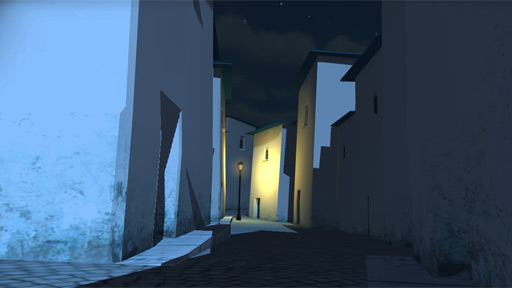
Zobeide, meanwhile, is a collaboration with sound designers Robin Arnott and Eduardo Ortiz. It's my super secret Proteus-killer. (... Well, not really.) In it, you build cities on top of other players' cities, chase naked women through moonlit alleys, and listen to the music that results. It is also an experiment with combining first person interfaces with hypertext, as a literary ode to Borges' Calvino's "Invisible Cities."
CondomCorps XL did pretty well at Jaime Woo's queer games show in Toronto. Apparently it's going to be on a Canadian TV news program too, or something? I'm going to do some more interface tweaks, add a silly campaign mode / narrative, and then call it done. I'm aiming to mirror the final feature scope of "Fear is Vigilance"... well, maybe half of that.
Radiator 1-3 might get dusted off. When I talked about it a few months ago at SVA, it reminded me how much I liked working on it sometimes. Maybe the San Francisco air will do me some good.
If you want to see any of these at GDC (or at the associated parties) come say hey at me, especially if you're a big important games person. Also, if you'd like to give me a job when I graduate, that'd be nice! My portfolio is here.
Monday, February 27, 2012
Koumei Satou working on a sequel to Mistake of Pythagoras? Or probably not.

Now, apparently, he has some sort of blog post where he's talking about workflow from Hammer to XSI Mod Tool to SketchUp to Hammer (?!) and it looks like some sort of sequel to Mistake of Pythagoras. The machine translation of the page doesn't provide much more insight, it sounds more like he's lamenting that everyone's ditching the Source mod scene for UDK and Unity. Am I reading correctly?
(Thanks to @Orihaus for the info)
Friday, February 24, 2012
Dear Esther

From the Wikipedia article on "cut-up technique," emphasis mine:
A precedent of the technique occurred during a Dadaist rally in the 1920s in which Tristan Tzara offered to create a poem on the spot by pulling words at random from a hat. [...] Gysin introduced Burroughs to the technique at the Beat Hotel. The pair later applied the technique to printed media and audio recordings in an effort to decode the material's implicit content, hypothesizing that such a technique could be used to discover the true meaning of a given text. Burroughs also suggested cut-ups may be effective as a form of divination saying, "When you cut into the present the future leaks out."
See also "unreliable narrator," "lyrical poetry," and "ludodiegesis." Though some people would rather argue that poetry is supposed to be straightforward and accessible and worth $10 of some arbitrary unit of entertainment?
I imagine it'd be fairly easy to rig Hammer to make custom Dear Esther levels. Coming soon: "Dearer Esther."
Monday, February 20, 2012
Unmanned, by Molleindustria
I'm a bit late to the party, but Unmanned is probably one of the best games I've played in a while.
It's a fantastic use of interactive fiction / first person sensibilities (some of which I'm going to steal) with innovative use of split-frame and achievements, contemporary relevance but also rather personal narratives... it's got everything.
If you're upset that it's not subtle enough, consider all the noise it's trying to combat, all by itself. You don't bring a toothpick to a knife fight, folks. Also, in case you missed it the first time, check out this game's distant cousin, "maybe make some change."
Funny how similar the premises of these two games' methodologies are: that text and only text can adequately communicate the psychological damage of modern warfare, and militaristic first person games thrive on the lack of text and introspection.
Pop music doesn't care whether you think it's authentic, though.
It's a fantastic use of interactive fiction / first person sensibilities (some of which I'm going to steal) with innovative use of split-frame and achievements, contemporary relevance but also rather personal narratives... it's got everything.
If you're upset that it's not subtle enough, consider all the noise it's trying to combat, all by itself. You don't bring a toothpick to a knife fight, folks. Also, in case you missed it the first time, check out this game's distant cousin, "maybe make some change."
Funny how similar the premises of these two games' methodologies are: that text and only text can adequately communicate the psychological damage of modern warfare, and militaristic first person games thrive on the lack of text and introspection.
Pop music doesn't care whether you think it's authentic, though.
Saturday, February 18, 2012
The shadow of the white cloud: architecture criticism at the 1893 World’s Fair and BioShock Infinite.

While the original BioShock’s diegesis focused on objectivism and the dangers of uncontrolled capitalism, Infinite’s level architecture is more about the dangers of American exceptionalism as exemplified by the 1893 World's Fair.
In my architecture seminar, the story of the World's Fair was a bit more nuanced than that, and it goes something like this:
Friday, February 17, 2012
"Prisoner" by Frank Lantz, a forgotten bit of "art mod" history.

Here's a bit of archaeology for you: in March 2003, a guy named Frank Lantz made a mod called "Prisoner." Google returns approximately zero results on this matter, so it's safe to say that pretty much no one's played this fairly early "art mod." In fact, it's so esoteric it makes my own art mod stuff look like Call of Duty, but I think by the end, through grace of repetition, it's still fairly straightforward and earnest. (Or if you're lost, you can take a look at his list of references to glean some meaning.)
The maps are incredibly spartan and unsophisticated by the standard of the Half-Life 1 mod scene at the time (Adam Foster's Someplace Else, Muddasheep's Half-Quake Amen, and unreleased thing called "Nightwatch") but again, much like with The Stanley Parable or Dear Esther, the point is that the author was an outsider, capable of making something more conceptually complex to compensate for the lack of technical finesse, or maybe we're all just full of artsy bullshit, who knows.
Still, it's neat to see what the current director of NYU's game design MFA program was doing about ten years ago -- well, other than living in Hoboken and playing a lot of poker -- so in the public interest, with Mr. Lantz's permission, I have repackaged it into a Steam-compatible Half-Life 1 mod for you to try.
1) Download it here, 2) unzip it to SteamApps\[account_name]\half-life\, 3) restart Steam, then 4) double-click on "Prisoner" in your game list. Again, you'll need a copy of Half-Life 1 on Steam to play it.
(Conceptually, it reminds me a bit of Ludum Dare 21 entry "Bathos" by Johan Peitz.)
Wednesday, February 15, 2012
Shilling for a friend: "Doodle Defense"
I don't normally shill, but when I do, it's for Kickstarters that explore new input methods. Doodle Defense, by Andy Wallace, could use a few of your Earth dollars. Draw on a whiteboard and watch colored things magically avoid them; ah, the magic of A*!
Tuesday, February 14, 2012
Jersey Shouroboros

The full write-up of "Jersey Shouroboros," me and Eddie Cameron's Global Game Jam 2012 entry, is up and over at Altercation blog. Check it out, along with some juicy gossip / dev anecdotes. Oh la la!
There's a link to the Unity Web Player build there, which you're welcome to try, but I really (really really really) recommend plugging in a PS3 or X360 gamepad to play it because apparently analog sticks are really important for feeling like an infinitely long serpent god / TV producer devouring Italian American reality show stars from Long Island but who moved to New Jersey. Who knew?
Saturday, February 11, 2012
"Stair K"; architecture criticism, Thief, and a coffee maker.

Longtime Parsons students and veteran faculty at the Sheila Johnson Design Center are forgiven if they have no idea what Stair K is, and where it leads – it is invisible, and it leads approximately nowhere.
Thursday, February 9, 2012
CondomCorps XL is crowd-sourcing fake orgasm sounds from you, soldier!

I'm currently re-mastering my Ludum Dare game CondomCorps into CondomCorps XL -- that is, making it minimally playable for humans -- and I just realized I need some sexy moaning sounds, yet I am only one person. Then I remembered the wonders of the internets and its powers of protein folding.
Unfortunately all the in-game character models (all one of them) will appear male, due to the nature of the patented bulge-gaze mechanic, so I would greatly prefer audio that "sounds like a man." (Non-men: please do your best impression of a man, or even your worst. Feel free to exaggerate / be silly. Drag is fun!)
> > > To submit:
Tuesday, February 7, 2012
"Lun3DM5: You'll Shoot Your Eye Out" by Matthew Breit and Andrew Weldon

They finally got it done; download the map / read Breit's write-up and Weldon's write-up.
Flipping through the screenshots, I'm not sure if I would've went with such a noisy concrete texture for this, as it kind of muddies up the real star here -- the ambient occlusion on the surfaces, the subtle lighting. I also would've went with some more color too. Though maybe with this, he wanted to differentiate himself more from Rob Briscoe's Mirrors Edge abstract speedrun-floater level treatments, and break away from the legacy of GeoComp2 with its demand for very plain textures. I guess in the end, the difference is pretty trivial, as we're just two different flavors of modernists.
I'm taking a lighting design class right now, and it's remarkable how useless it is in the context of real-time game lighting solutions that have no concept of bouncing light or glare -- that's partly what an ambient term, SSAO, and HDR are supposed to simulate.
The paradox is even weirder the more I think about it. Commercial lighting design is all about avoiding harsh shadows, but in the days of the Source Engine, people were obsessed with mimicking the pitch-dark high-contrast shadow projections that aren't photorealistic nor terribly flattering nor well-stylized, yet are still subject to the weaknesses of static lighting. (My history: many were upset that Source didn't have stencil shadows like the other engines, unaware that Source's radiosity tool was much more futureproof anyway; Unreal ended up focusing on lightmap baking too.) It was like hitting no birds with two stones.
The paradox is even weirder the more I think about it. Commercial lighting design is all about avoiding harsh shadows, but in the days of the Source Engine, people were obsessed with mimicking the pitch-dark high-contrast shadow projections that aren't photorealistic nor terribly flattering nor well-stylized, yet are still subject to the weaknesses of static lighting. (My history: many were upset that Source didn't have stencil shadows like the other engines, unaware that Source's radiosity tool was much more futureproof anyway; Unreal ended up focusing on lightmap baking too.) It was like hitting no birds with two stones.
My lighting design instructor would cry if he knew what most of us have done: letting our technology fetish get in the way of good ol' artistic composition. However, I think he'd be okay with what the boys did on this very pretty level. Maybe I'll show it to him.
Also, I think Matthew "Lunaran" Breit should, um, share his CubeSpew Python script for Maya. Let's protest by joining servers running this map, and standing still. I propose the hashtag #OccupyLunaran.
Saturday, February 4, 2012
Levels that make me want to start using UDK
I still really like Unity, don't get me wrong, but it'd be nice, sometimes, to be able to slather post processing on everything without breaking a sweat. Here are two UDK levels that are really awesome looking and don't rely on the default UDK assets, which is so much of the UDK stuff I see out there. (I also wish Dead End Thrills would feature indie work more often, like, 99% of the time.)
Animal Memory (Test 01), by Jack "Gauss" Monahan. Download here. Find all the pink cassette tapes, just like the cool kids in Tony Hawk games. My critique to him -- it's so postmodern cool-looking that I found the level very difficult to navigate. Masterful use of color and silhouettes though, of course. Next build, I believe, Mr. Monahan plans on adding mans to shoot.


Hubris, by Andrew Yoder. Download here. Not much to do here, other than walk around and be freaked out by the ambient sounds. He cites me (oh dear) and Dan Pinchbeck as his inspirations. The models and forms are technically very simple, and sometimes that's more of statement than fancy cubemapped parallax stuff. It's like Ico HD on acid.


Animal Memory (Test 01), by Jack "Gauss" Monahan. Download here. Find all the pink cassette tapes, just like the cool kids in Tony Hawk games. My critique to him -- it's so postmodern cool-looking that I found the level very difficult to navigate. Masterful use of color and silhouettes though, of course. Next build, I believe, Mr. Monahan plans on adding mans to shoot.


Hubris, by Andrew Yoder. Download here. Not much to do here, other than walk around and be freaked out by the ambient sounds. He cites me (oh dear) and Dan Pinchbeck as his inspirations. The models and forms are technically very simple, and sometimes that's more of statement than fancy cubemapped parallax stuff. It's like Ico HD on acid.


Friday, February 3, 2012
Games @ Parsons

Hey all, just a brief plug -- me and my fellow students / faculty at Parsons are starting a new initiative to talk about the stuff we do in graduate-level game design studies. This public research blog is called "Games @ Parsons" -- we'll analyze indie games, post our own experimental prototypes, try to situate your favorite games in the context of academic research, announce cool NYC events for you to attend, and generally just be cool because school is cool.
Thursday, February 2, 2012
Skyrim, Steam Workshop, and the means of mod distribution
Auto-updating Skyrim mods sound amazing to me, but you have to wonder what will happen to the existing infrastructure; this move is extremely disruptive. Will Skyrim Nexus become a ghetto of unlicensed content / adult mods? ModDB will miss out on this entirely too. Sure, they'll say Steam Workshop is "optional" -- but if all the best mods are auto-updated with one-click installation, the player base will move and it won't really be optional anymore.
As Bethesda moves to weaponize mods like no one else before, and assumes an Apple-ish App Store relationship to its games and peoples' mods, you have to wonder what the effect of oversight and censorship will be.
Can your Steam account get banned from the Steam Workshop? If you make works that are critical of Bethesda's practices, can they just ban and silence you forever? Will there be room for LGBTQ-themed content or will it be institutionally repressed, as on the App Store? What if people start harassing your Steam account because you made a mod they didn't like? Is this more than an attempt to make sure they don't have another nudity-mod ESRB scandal that rocked Oblivion?
That isn't to say Skyrim Nexus doesn't police / censor their content too, but they certainly had a lot less to lose.
Game mods, like all games, can be used as political forms of speech. It's always a little spooky when someone decides to change the means of distributing that speech. We might not realize what we've lost, if anything, until it's gone.
Maybe everything will be fine and it'll be a new golden age of mods... or maybe we'll be setting up tents to occupy the Steam Workshop one day. What could be paradise here and now could just as easily become hell itself.
Saturday, January 28, 2012
THAT Mod, by Axel "Xenon" Shokk
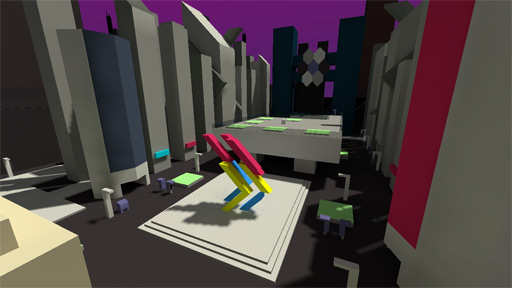
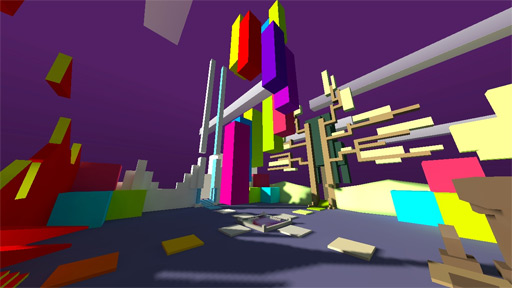
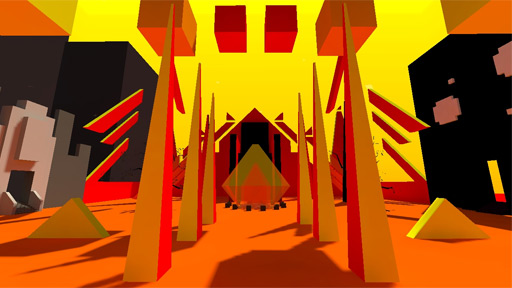
I just wanted to remind people that this existed, because it didn't get nearly as much coverage as it deserved. It reminds me of an alternate universe GeoComp, where Sparth wouldn't have been so heavily influential in emphasizing economy of form rather than some crazy acid-induced color vomit -- and I truly use the word "vomit" in the best sense possible because walking through these places is fascinating as Xenon dances on the edges of realism so delightfully. Again, we must thank the indie FPS community.
I also remember reading somewhere that he was working on a sequel in Unity3D...
Download THAT Mod @ ModDB. (132 mb)
(Source SDK Base 2007 required... so basically, it's free.)
Wednesday, January 25, 2012
The joys of using world space / procedural UVs for Unity3D
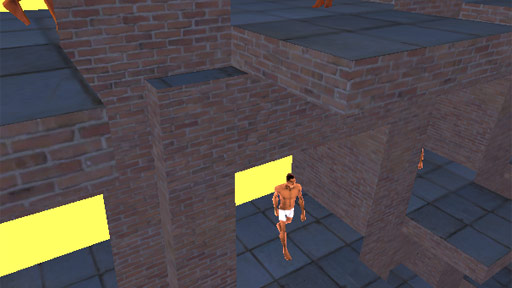
One of the greatest benefits of old Quake-lineage BSP systems is managed UVs for world geometry; move your polygons wherever you want, and let shaders texture and tile them properly. It lets level designers focus on building, and frees environment modelers to focus on geometry rather than the mundane work of UVing and texturing yet another concrete wall.
If you're an indie developer doing the work of both, well, any shortcuts are welcome. And if you're not thinking about these things, then just ask yourself whether the player's going to look at this thing you're modeling for more than a few seconds. Just use a block and let the engine worry about it.
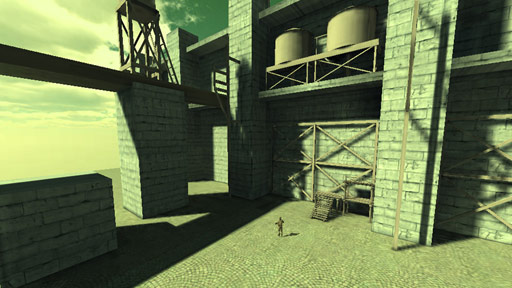

Here's the shader I've been using for my projects, slightly modified from something I found on Unity3D Answers a long time ago. I found it after a lot of fruitless digging through significantly worse implementations -- one editor script destructively re-UV'd all the meshes in your scenes, the other script did some weird thing with material offsets -- just leave that all at the door and use a shader-based solution, trust me.
Friday, January 20, 2012
Level With Me, a post-mortem / some unnecessary notes / dear players, it's no longer okay to not know how video games work.
Game design relies on a theory of mind for players. By that measure, many mainstream commercial games think players are utter simpletons and strive to explain every single thing -- Arkham City will have the Penguin frequently tell you how upset he is and how many enemies are left in the room; tool-tips will remind you that, yes, that glowing electric plate is electrified -- if you prefer your games to talk down to you, to patronize you, then I'm sorry you're going to be disappointed with this mod.
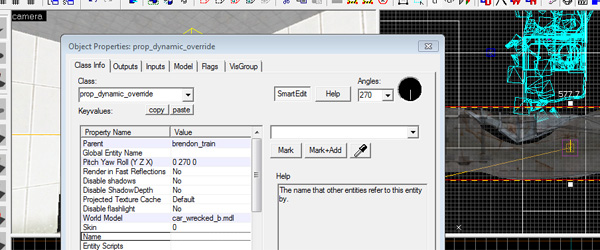
Then I watched a "Let's Play" of Level With Me, even the grueling hour or two where he's stuck at the end of chapter one -- and at the end of the whole playlist, he says he doesn't think he "got it" and wants an explanation. Well, whatever you took from it is what it meant. You don't need me to tell you what it means. (This, perhaps, is what the anti-intellectual "pretension police / gestapo" understand better than anyone else.)
Nonetheless, given his struggle and triumph, I'll honor his request. If you can't bother playing the mod, check out his Let's Play Level With Me playlist on YouTube. Now, here's an explanation of my intent and one possible reading of the mod. There are MASSIVE SPOILERS. You were warned:
Saturday, January 14, 2012
Tales from Zobeide


Postcard from Antiquity

Monday, January 9, 2012
Postcard from Yorda
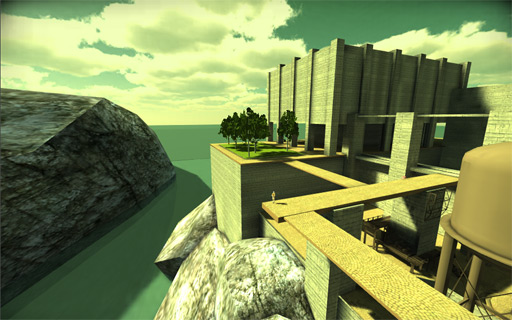
Right now I'm just improvising a giant castle thing, and then I'm going to sprinkle some gameplay in there or something -- I've left some empty spaces for puzzles, whatever those will be. Try out the v0.3 prototype here, which'll probably be the last public prototype since so much of this one is about novelty:
http://dl.dropbox.com/u/19887116/yorda/03/yorda3.html
(click to walk, double-click to run, or just sit back and let the pathfinding work its magic)
Thursday, January 5, 2012
Postcard from Zobeide
Thursday, December 29, 2011
About "Territory"

Part of it stems from my longstanding distaste of games criticism / writing that doesn't readily offer a translation from theory into practice, an opinion that probably isn't popular with most writers (the idea that criticism must be "useful" otherwise it's just whining) so I won't dwell on it.
Perhaps the hypothesis here is that words alone aren't the best way to discuss games. Discussing games is maybe a job best left for games: instead of writing 750 or so words on a game, a reviewer should make a short game about the game. Readers' comments would take the form of mods and new levels, mutations of existing rulesets and graphics to make a new point. (Eventually, some enterprising online pharmacy will code a spambot that will make spam levels and spam games.)
But for that glorious future to happen, I guess we need to think more about how we "read" games. As game designers, we're always deeply concerned with how players behave and think. Territory might help with that.
Truly, some pieces of games writing really shine with an additional layer of interactivity, although there's probably a tendency among those who call themselves gamers to disregard these interactions as "gimmicks," as if every digital interaction must require repetition, time, and mastery. Without those elements, these aren't games...
... Because games have mechanics! "Games aren't X!" But every time you say that, it doubles as an open invitation to the entire world to make a game that is exactly X. Maybe even 2X.
(A related tangent: these days, toddlers learn how to swipe, pinch, and click, before they ever learn how to spell or type words. What do we make of that?)
Anyway. If Territory is successful, I'll open it up to wider participation and start playing matchmaker for games writers / game developers. For now, I've talked to a few people and I'm planning on making small games based on their essays. It's a test run. We'll see how it goes. If it ends up failing, well, let this post be a testament to my completely benevolent and well-meaning intentions.
Thursday, December 22, 2011
Level With Me, a Portal 2 mod

STARING EYES! It's unofficially Radiator vol. 3, and the only mod I'll have put out in the last two years. Watch this space as release is pretty imminent, and thanks for reading. We'll see if people hate it or love it.
EDIT: It's out now. Try it out. A typical run-through for me is about 30 minutes long, so that means it'll take the average Portal 2 player about 1-2 hours. If you get stuck on the first chapter, then just skip to the second, it's really not a big deal.

Friday, December 9, 2011
Radiator Blog: Two Year Anniversary

Yes, that's right, from all one of us here at Radiator Blog -- happy anniversary, we're two years old now. In keeping with last year's tradition, here's a "best of" compilation from December 2010 - November 2011 and a bit of commentary with the benefit of hindsight. These were generally the articles that got a high volume of page views / attention from Sunday Papers or Critical Distance or whoever, though I also included some ignored ones because I still think they're decent reads. At any rate, thanks for reading.
GAMES I MADE
- CondomCorps. The prototype is pretty unplayable, but I still want to re-visit the idea of peeping into hotel windows to make sure gay orgies take-off without a hitch. The best part was reading a game studies undergraduate's blog post about it, arguing it was unethical to weaponize sex education like this or something.
- Polonius. An FPS with multiple characters, where you have to eavesdrop on a couple's conversation as they walk around a crowded plaza. I liked the mechanics here and want to come back to this, it just needed some tutorial levels and some more massaging. Based on the film, The Conversation. (collab w/ @eddiecameron)
- FuhFuhFire. Rescue people from a burning building -- or maybe not. I feel like the mechanics here were pretty sound, I just need to redo the level design here and make it prettier.
- Apollo 2. I made a very short FPS in zero hours. I'm pretty satisfied with what it is.
- Super Cult Tycoon 2. Guide your very own cult from a van and a barn to a sprawling complex with Kool-Aid factories and counterfeit wallet exports. Got a ton of coverage on Kotaku, PC Gamer and Indiegames.com. (collab w/ @eddiecameron)
GAMES AND CULTURE
- "On the first person military manshooter and the shape of modern warfare" argues that games like Call of Duty are unethical NOT because someone's going to go on a shooting spree, but because they're making us think war is something you can win.
- First Person Films comes from watching Enter the Void and thinking the first 15 minutes were more interesting than everything else.
- Me, and I think a lot of other people, were disappointed a little with Portal 2 because it was pretty much just a faster horse. A fantastic horse, of course, but still just a horse.
- People are freaking out about Portal 2 level editors being used in schools. Hopefully they won't copy the mistakes of Logic Quest 3D, an obscure edutainment FPS with a built-in level editor -- that is, a warning from 15 years ago.
FORMALIST DESIGN THEORY
- Part 4 of the "Dark Past" series on immersive sims ended with an attempt at reviving Randy Smith's "valence theory" (my word for it) as used in Thief games.
- I apply Chris Crawford's concept of "process intensity" to procedural narrative. The post doesn't really have a point in the end, but it's nice to try to sort out what's happening in the field today, even if we're going to end up failing.
- Here's Dan Pinchbeck's PhD dissertation, summarized in a blog post. The idea to take away is "ludodiegesis," which basically argues that the world tells a story. I like it because it's a very neat shift away from the crassness of "environmental storytelling" and ties back into film studies.
- My close-reading of Mass Effect 1's Noveria demonstrates how I go about analyzing level design. Don't say bullshit like "the blue barrels and leading lines guide the player's eye, blah blah blah" -- that's not how players play games. We need to look at how environments afford gameplay, and then see how we can co-opt those same affordances for a narrative effect.
- Love letter to a bridge is in the same vein. In de_aztec, visuals and mechanics combine into something that's just a really elegant piece of design.
GAMES AND ART
- "It belongs in a museum" argues that games don't belong in museums. Prompted, in part, by Pippin Barr's excellent game, The Artist is Present.
- Butte, Montana. 1973 is a board game about open-pit mining disasters -- and in the end, you'll create your own chemical spill that's problematic to clean-up. I think board games are ripe for a revolution in materials and narrative; let's fight the cold proceduralism of German board games with all our strength.
COMMUNITY
- Welcome to the Indie FPS is a round-up of 5 people doing cool fun things with first person shooters; I argue they all take their cues from Myst instead of Doom. The most haunting thing is the eerily prescient NYT review of Myst that I unearthed during my brief bit of research.
- There used to be a Valve-sponsored modding community called the VERC Collective that had peer-reviewed articles about design theory / coding stuff. It was really cool. I wish there were researchers archiving the rise and fall of these internet communities -- you can literally trace lineages of game developers and creators from these places. These were our think-tanks.
- In April 2011, I declared the Death of the Mod. We used to think total conversions were the "epitome" of craftsmanship, a "world wonder" of the modding community. Now that notion is more or less dead, replaced with the idea that you're squandering your output if you're not going indie and selling your stuff in a standalone.
- A Closed World was an MIT-Gambit research project to make a game about LGBTQ issues. Me and some other self-identified LGBTQ indie game devs kind of got upset about it.
Tuesday, December 6, 2011
Portal 2 Modding Minutiae
While working on Level With Me, I've gathered a set of random Portal 2 modding knowledge that might be useful. Please profit from my trial and error:
- If you want to have your levels selectable from the menu and everything, you have to make your own custom VPK to override some menu scripts, and reskin the "Extras" menu to appear to be the single player menu. Marcus McKay has a comprehensive tutorial here.
- Currently, custom sounds don't automatically get added to the sound cache, so you'll always get errors that the "file is missing from the repository" or something when you play the sounds in-game. You can either re-build your entire sound cache every time, or use PakRat to pack the sounds into the BSP. It's just another extra step to the map compile pipeline. More details here.
- Switching videos dynamically, in-game, is kind of problematic. Only the first set of .BIK files get cached, so when you load the rest, there's a slight hitch. Maybe if you make a set of invisible vgui_movie_display entities in some hidden room, the map will pre-cache those files? Also, to switch a movie, the only method I've been able to find (with varying degrees of success) is to send a "TakeOverAsMaster" input to a former vgui_movie_display slave, which seems to "refresh" the entire entity group.
- The lighting in the elevator rooms will only work if you compile vrad.exe with -staticproppolys or something, otherwise the ceiling rotors always block the light_spot entity. It's a feature.
- When you buildcubemaps, you have to quit, use mat_reloadallmaterials, then load the map again to get the cubemaps showing.
Tuesday, November 29, 2011
Level with Me, screen test 2
There are still some weird encoding errors (video editing isn't my strong suit) but if you ignore it, you can just watch and enjoy some handsome men profess their deepest beliefs and feelings about video games. Production on the mod is lagging a bit behind, but I think I'll be okay once I crunch on it this weekend.
Saturday, November 26, 2011
Critical Information at SVA, 3 December 2011
Next Saturday, I'll be talking about Radiator 1-2 ("Handle with Care") at an art criticism conference called "Critical Information" hosted by School of Visual Arts in New York City. If you happen to be awake and in Manhattan that Saturday morning, around 10 AM, stop by and drink some complimentary coffee; it's free and open to the public.
You might just end up feeling terribly bored because I'm going to have to explain a lot of game studies concepts / theory that you'd already be literate in -- it's a digital, but non-gamer audience there -- but it should make for an exciting live demo (?!) nonetheless.
Though honestly, I'm a little nervous, as Radiator has always been more of a "gamer's art game" than something anyone off the street can just pick up and comprehend. (Even worse, only gamers understand what a "gamer's art game" might entail.)
You might just end up feeling terribly bored because I'm going to have to explain a lot of game studies concepts / theory that you'd already be literate in -- it's a digital, but non-gamer audience there -- but it should make for an exciting live demo (?!) nonetheless.
Though honestly, I'm a little nervous, as Radiator has always been more of a "gamer's art game" than something anyone off the street can just pick up and comprehend. (Even worse, only gamers understand what a "gamer's art game" might entail.)
Wednesday, November 23, 2011
Process as pastime
This post will be published (or so I'm told) in new media journal Switch v28 but I'm just cross-posting it here since that might take a while. I was asked about "process." I came up with a rant of sorts, that basically attacks everyone except Glorious Trainwreckers / Pirate Kart people. Please don't be offended; polemic is just too much fun to write:
“Process” is a heavy word in video game design.
It refers to procedurality, the ways in which a computer manipulates or generates data. It also refers to proceduralism, the idea that a video game is a formal system of rules and interactions, not a narrative nor a simple toy. Most often, it refers to the iterative process, the act of prototyping over and over again until the game is least awful. The game industry and nascent game development schools they sponsor would have you believe that best practice involves mastery of all three. They want you to think the act of making video games is some sort of art or science, an arcane magic performed only by hyper-literate and experienced masters.
And they're right. For now.
“Process” is a heavy word in video game design.
It refers to procedurality, the ways in which a computer manipulates or generates data. It also refers to proceduralism, the idea that a video game is a formal system of rules and interactions, not a narrative nor a simple toy. Most often, it refers to the iterative process, the act of prototyping over and over again until the game is least awful. The game industry and nascent game development schools they sponsor would have you believe that best practice involves mastery of all three. They want you to think the act of making video games is some sort of art or science, an arcane magic performed only by hyper-literate and experienced masters.
And they're right. For now.
Saturday, November 19, 2011
On the first person military manshooter and the shape of modern warfare.
 |
| from "Photographs of the War in Afghanistan" |
The main message, coming from a war photographer and national security journalist, was a decidedly ethical message: Today, war is invisible and nearly impossible to photograph. And that is a dangerous thing.
So if you ever see a photo of a guy aiming a rifle, remind yourself -- that's not war.
Instead, they argued that war is an agonizingly slow, decade-long game of chess. War is the US spending billions to magically airdrop and sustain a city of 45,000 people in the middle of Nowhere, Afghanistan. War is a guard tower built next to a tennis court. War doesn't take place on a battlefield, but a "Battlespace" that encompasses every facet of modern life. War is an unmanned drone with 96 cameras, sending back footage for 200 intelligence analysts to dissect before going home to eat pancakes. War is a cheap internet router that may or may not have fed data to Chinese intelligence agencies (EDIT, March 2017: finally updated this link to not go to a weird conspiracy blog).
Tuesday, November 15, 2011
"Water" mod is out.
From the HL2 Short Story team comes "Water," a third person adventure game with some light turn-based combat, clever NPC-based puzzles, and really pretty environments. When I alpha-tested some earlier versions, it was already pretty solid and playable, so I can only imagine it's even nicer now.
You only need Source SDK Base 2007 to play, which comes with any Source-powered game. So you probably have it. Just go and download / play this fitting swan song of a seven year old mod community. It'll last you a good hour or two.
Saturday, November 12, 2011
What I'm Working On

Souvenir is a first person VVVVVV-style puzzle game about growing up. It's the design thesis of me and 2 other students. We're in the middle of production right now.

Zobeide is a first person / hypertext hybrid based on Italo Calvino's "Invisible Cities." Play an early prototype / follow progress on it here.
As for Level with Me? The next installment is Brendon Chung. Still a lot of transcribing left to do.
As for Radiator? Gah. I'll have time this coming winter break, the last half of December / first half of January. I really want to push it out the door because now it's just more like this lingering regret.
... now why did I install Skyrim?!
Tuesday, November 8, 2011
It makes you wonder...
... what it would be like to date Adam Foster. First he'd show you his potato connected to an Arduino. Then he'd whisk you off to some decaying factories and take hundreds of photos of doors.
You'll waver at times, but then you'll take a nice long sip from your Cherry Fanta and think, "as long as we don't miss that 8 o'clock showing of Paranormal Activity 3, he can photograph as many cracked concrete slabs as he wants."
No, I'm the only one who wonders that? Okay. Never mind. Ignore me.
You'll waver at times, but then you'll take a nice long sip from your Cherry Fanta and think, "as long as we don't miss that 8 o'clock showing of Paranormal Activity 3, he can photograph as many cracked concrete slabs as he wants."
No, I'm the only one who wonders that? Okay. Never mind. Ignore me.
Sunday, November 6, 2011
0 Hour Game Jam: "Apollo 2"

UPDATE, 8 May 2017: due to this game's only super-fan's special request, this has been ported to WebGL. You can now play it here on Itch.io.
Wednesday, November 2, 2011
Super Friendship Club's "EDITOR" pageant, Nov 1 - Nov 30

Yes, Super Friends... it's that time again.
You now have one month to make a game that includes some sort of level-editing component, along with some mechanism for sharing levels. It's not nearly as hard as you think.
A "level" can be anything. A "game" can be anything. An "editor" can be anything. Just make something.
Check out Mr. Lavelle's advice and some more helpful info here.
Good luck!
Level with Me, Jack Monahan
UPDATE 2: The second installment, with Polycount fixture Jack Monahan, is now up. Read part 2.
It's been pretty quiet around here... that's because I've been spending all my time recording interviews, transcribing them, editing them to make people sound smart, etc. Why did no one ever tell me this "game journalist" racket was so much work?
The first installment of "Level with Me," this time with the naturally smart-sounding Dan Pinchbeck, is now up at Rock Paper Shotgun for your perusal. Read part 1.
It's been pretty quiet around here... that's because I've been spending all my time recording interviews, transcribing them, editing them to make people sound smart, etc. Why did no one ever tell me this "game journalist" racket was so much work?
The first installment of "Level with Me," this time with the naturally smart-sounding Dan Pinchbeck, is now up at Rock Paper Shotgun for your perusal. Read part 1.
Monday, October 31, 2011
Cross-post: Dinner Secrets

Picking at the patinas of dead levels

It functions in the same way that a ring road might denote the former existence of a city wall, building cities on top of cities on top of cities. Levels function the same way, existing as iterations layered over each other -- a virtual patina that exists only in context to the rest of the level.
Western societies value this patina. We preserve buildings, we have a "National Register of Historic Places." Something old is something inherently valuable... Meanwhile, you get the Chinese government bulldozing hutongs and re-painting the Forbidden City. I'm a proponent of the former approach in real-life, so it's interesting that I don't nostalgize virtual environments in the same way at all. Why wouldn't you fix problems and smooth the cracks? That low-detail room and seam in Favela is a bug. And here, we squash bugs. No one lives in my levels, and there are no stakeholders or community councils to notify about the impending demolition.
But consider this. Someday, you will have a 9 year old child. You will point out the neighborhood you grew up in, and the streets where you used to play. She'll laugh; CS 1.6 is a 32-bit cold program, it's barely compatible with today's average quantum biological wetware. And de_dust... why, she can see the pixels in the textures! It's all laughable, really. It's great though, that you took the time to show her how video games used to be so old and obsolete.
You'll stay silent and mime a chuckle. That's when she'll realize she's hurt your feelings, and that's how she'll learn the weight of the dead is always shouldered by the living.
Counter-Strike: Global Offensive is currently in private beta testing.
Friday, October 21, 2011
The 2012 IGF Pirate Kart

I've submitted my Ludum Dare games, CondomCorps and FuhFuhFire, to the 2012 IGF Pirate Kart. Also, me and Eddie threw Super Cult Tycoon 2: Deluxe Edition into the mix too. That's 300+ incredibly creative games, all in one package, all full of love. So go play it.
Tuesday, October 18, 2011
It's Altercation Time.

www.itsaltercationtime.com
Me and Eddie Cameron are now formally releasing our Unity3D stuff as a dynamic duo: "Altercation." The plan, I think, is to go back through our other stuff and polish those up to spec too? Maybe?
Our first official game is a more polished build of our most recent game, "Super Cult Tycoon 2: Deluxe Edition," now updated to version 1.0 -- with better difficulty ramping, some more graphical fanciness, and exponentially more playability.
+1 branding.
Saturday, October 15, 2011
Frontiers, and why I'm afraid of working with multiplayer.

This is why "serious games" and messaged-based games, in my mind, should never require more than a handful of players (or ideally, 1 or 2) to deliver its rhetoric -- or they should use asynchronous multiplayer -- because this is how a game dies. In contrast, single player games live forever.
I don't want to say, "don't make real-time multiplayer games," because that sounds awful. But I guess I'm saying it. I don't see any way around it.
Friday, October 14, 2011
Attention! Oct 21-23 = upcoming epic weekend of game jams!
For some reason, Sagittarius is aligning with Capricorn in the zenith of Jupiter and three (3) different game jams are happening on the weekend of October 21 - 23. If you live in or near a major economic center in the United States, you're in for a treat. Hopefully we can get some kind of simultaneous live camera feed going on between the sites.
6 East 16th Street, (12th flr lab), New York, NY. (Take the L / N Q R / 4 5 6 to Union Square.)
NEW YORK CITY:
hosted by Babycastles / Parsons, the New School for Design / New School Game Club
Friday, Oct 21 @ 7 PM - Sunday, Oct 23 @ 7 PM. (NOTE: building is NOT open 24/7.)6 East 16th Street, (12th flr lab), New York, NY. (Take the L / N Q R / 4 5 6 to Union Square.)
> Free. Sign-up on the Facebook page, or just show-up. (+ Free pizza on mystery night!)
CHICAGO:
hosted by IGDA Chicago and Friends / Toy Studio
Friday, Oct 21 @ 6 PM - Sunday, Oct 23 @ 10 AM.
1550 N Damen, Suite 201. Chicago, IL.
> Free (?) Sign-up here.
SAN FRANCISCO / BAY AREA:
hosted by TIGSource / Hacker Dojo
Thursday, Oct 20 @ 10 AM - Sunday, Oct 23 @ 8 PM.
140A South Whisman Rd., Mountain View, CA.
> Registration required ($50) for t-shirt, snacks, dinner and more.
If you've never been to a game jam before, don't be scared. Anyone can start making games. These days, you don't even have to learn much computer programming if you don't want to. For info and advice on starting out, see this thread at Super Friendship Club or visit youcanmakevideogames.com!
And if you're unfamiliar with the game jam format, it roughly resembles this:
- First, you show-up and sign-in and stuff.
- The secret theme is announced. You listen to a silly but inspiring keynote.
- People form teams and talk about ideas.
- People start making games. People eat. Good times are had.
- People go home and sleep, or the building closes.
- People start panicking that they won't finish. Cut some features. Go home and sleep.
- Cut more features. The timer starts ticking down.
- Pencils up! Everyone presents their broken games and everyone is loved.
See? Nothing to be scared of. So see you at one of the jams! Come make games!
Subscribe to:
Comments (Atom)